“That we've broken their statues,
that we've driven them out of their temples,
doesn't mean at all that the gods are dead.
O land of Ionia,
they're still in love with you,
their souls still keep your memory.
When an August dawn wakes over you,
your atmosphere is potent with their life,
and sometimes a young ethereal figure
indistinct, in rapid flight,
wings across your hills”
Constantine P. Cavafy

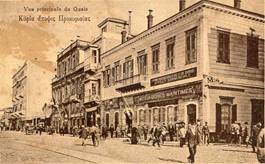
Today is September 8th, 2007. Eighty five years ago it was the final day of a great dream by Venizelos that was called ‘To megalo idea’ (The big concept). Thousands of people, citizens and refugees from neighboring areas have gathered in my city of Smyrna awaiting their destiny after just a few years of liberty and rejoicing. They did not know what would become of them, but their thoughts were centered on the fact that they were the real owners of this land, that for centuries no force was able to uproot them from Asia Minor. Countless conquering armies including Persians, Temurlenk, Selchuk Turks and Ottomans faced the same reality that in the end these lands were inhabited by Hellenes, and it was their motherland, and they would not leave it regardless of oppression and hardship.
On September 9th, 1922 Turkish National forces entered Smyrni (today, Izmir in Turkish), occupying it, and after burning down the Armenian and Greek quarters, got rid of the remaining Orthodox Christian people by actually forcing them into the sea. After eighty five years there are just a few remnants of these people who had changed the course of history, the music of a

whole nation, the arts and philosophy of the Western Civilization several times over. But today, they are lost in the pages of history books, a few articles and documentaries. This is a short history of Smyrnean Hellenes in the late 20th Century by a Smyrnean Greek who has lived most (if not all) of his life in the city.
The Hellenes of Asia Minor survived. A small Greek population in Smyrni survived with the help of their neighbors, some in the wider Aegean region in remote villages did by the rule of proximity. But then the Lausanne treaty forced most to take part in a population exchange of Muslims of Greece with the Hellenes of Anatolia. Two million Greeks moved to Greece and some 300,000 Muslims moved to Turkey. But again Hellenes of Asia Minor survived mostly in Constantinopolis (today Istanbul), Smyrni and Eastern Thrace. The Christian population of these areas was excluded from the treaty so many families moved to these pockets to prevent exile which meant losing their property and worldly possessions.Giorgos Seferis (1900-1971), a fellow Smyrnean and Nobel Prize Winner in Literature put it the best; “Who will discover the truth? The wrong has been committed. The important thing is who will redeem it?"

There has been a commotion going on the streets for a few days now. Smyrneans are preparing for the great yearly celebrations of September the 9th, the day of ‘liberation’ of Smyrna from ‘the Greek yoke’. The day Turks ‘finally put the Greeks to the sea’ to declare independence in Asia Minor, later founding the Turkish Republic. The day Greek civilization lost its foot in one of the major areas of cultural influence, Ionia, the land of Homer (not Simpson).
At a university meeting, a few years back in Constantinopolis’ Bosphorus University, I was among a bunch of international students, Greeks included. As usual the subject matter danced around the fact that ‘Turks threw Greeks into the sea in Smyrni’, and jokes were made and people exchanged ironical remarks. One of the Greek guys suddenly pulled his pants down, to show he had bathing trunks instead of boxers as he said ‘I am prepared! We Greeks know how to swim. But I wonder what should happen if you guys try to follow us.’ It was really good and ended the discussion. It was also good to see the levelof maturity coming from my fellow countryman.
But how should I explain the joke to descendants of thousands of Greek families of Smyrni? The joke was on them! The celebrations commemorating the birth of a modern nation is based on destruction of the civilian people of the city. Of course, this is a fact that is omitted from school books. They boast the fact that they have dumped the enemy into the ocean, but omit the fact that the very enemy were only the civilians of the city. The Greek army has already deserted the area.
For those who remained, then came the ‘property tax’. After two decades of rebuilding, recuperation and lessons in survival, the so called minorities of Turkey were up against a fascist law of discriminating ‘property tax’ of the forties. Turkization (a term borrowed from Matthew Barrett, or Turkification) of Asia Minor, which began in 1860’s, through the Armenian genocide and uprooting of Pontus Greeks, Assyrians and Kurds, was not able to get rid of all non Turkic elements from the area. In fact together they outnumbered Turks in every aspect. The final blow in that endeavor was to adopt a law that was influenced by National Socialism prevailing in Germany at the times. This law stated that all non-Muslims had to pay a special tax

proportional to their property or to face exile to the working camps in Eastern Turkey, with a glitch on the word ‘proportional’. The aim was said to be the dwindling conditions of the state during wartime, but there was no explanation as to why only the minorities had to give a hand to the government who refused to take part in the war officially but covertly supported the Axisforces in every manner.
The glitch on the ratio of the tax was the fact that it was not a percentage; it was a multiplication factor! A non-Muslim who for example owned 1000 lira worth of land had to pay, say 10000 lira (Yes, ten thousand) worth of taxes, or else to the working camp where they had to help build a railroad under harsh conditions of winter in mountainous Eastern Turkey. Many Greek, Armenian and Jewish families sold everything they owned for ludicrous prices and fled the country. The many Armenian craftsman of Istanbul had to bribe the authorities to keep their stores; those who couldn’t had to actually go to the work camps only to die there. It was the final major tragedy that today no one ever talks or writes about. Thousands of craft shops, factories, trading stores changed hands during these years, and again thousands of residential and communal real estate fell into the hands of Turks including even some church buildings.

Finally the majority of the economical forces of Asia Minor were in the hands of Turkish ‘entrepreneurs’, and the only evidence of all that happened were in the memories of Asia Minor Hellenes (Roumoi) and Armenian Diaspora. The tiny and poor Greece to the west was no major threat both in military or political terms. But there was a little pocket of land left where Greeks were living side by side with Turks: Cyprus. (Except maybe Western Thrace where the Muslim population was living-they still do-as Greek citizens with rights to follow their religious ways and to education in their language.)
Then there was the Cyprus crisis. In 1955, the masses in Constantinopolis, already uneasy because of the news from Cyprus, were agitated by the authorities with a lie that the house of birth of Mustafa Kemal, the founder of Turkish Republic, in Thessaloniki was bombed and burned down by Greeks. They immediately formed a mob to destroyed everything they related to a non-Muslim in the city. They burned Churches, apartment buildings, actually every building that did not post a Turkish flag. The official toll was 11 murders, hundreds of wounded, 73 churches, 1 synagogue, 26 schools, 8 fountains, 2 monasteries and 5538 properties destroyed. The authorities gathered up the usual suspects; the communists including four writers. Nobody got any jail time or punishment. A record of Turkish eye witness summarizes the tragedy. Astore owner tells his story:
“I took the Greek kids to their homes and arrived home. Our house was just across from the mosque. My grandma was sitting by the door, trembling and crying. When she saw me she said; ‘My son, please do not touch anybody’s belongings, these are our long time neighbors’, and cried more. Somehow, some time later someone brought a plate stolen from Greeks to our house. My grandma refused to touch it and she said: ‘I won’t let this thing enter my home, we would be done with’. To the last moment we were with Anastas and Niko, the pastry shop owner. We resisted against the demolition of the pastry shop to our capacity. But then a huge crowd arrived, oh, they were too many for us, they finally tore the store down.”
Between 1955 and after the events of the Cyprus conflict in 1963, the majority of Hellenes left the country for Greece and the United States. But that was an exile in reality. They did not want to go. The following personal account tells the story:
“We, most of us, had forgotten the events of 1955. They say, even some Greeks say, that we left after 1955. No, we did not leave after 55, maybe only 50 families (from Istanbul-author’s note) left then. But after 63, Cyprus was on fire, demonstrations, megaphones everywhere, on every wall in Istanbul it was written ‘Death or division!’, ‘Citizens speak Turkish!’, it was impossible for us and that was the fact. We were afraid to even say our names, to admit that we are Greek. We used to tell the kids that they should not speak Greek in public or if they have to, to speak in a low voice. You can immediately see the changes in people’s faces when they recognize you. This is my fatherland. I was born here, I lived here, as did my mother and his as well. How can I go? We are not immigrants; I am not one of these who went to America. I love my fatherland, I also love Greece. Then the immigration started in 64 after 63. We never meant to go. My husband used to say: ‘If we have to, let me be the last.’”
Personal memories fell into this timeframe. My mother being of Circassian origins, and my name Turkified on the books to prevent me from mishaps as my father used to tell me, I had no serious problems growing up in the 60’s in Smyrni. But then there was school. They had copies of my papers and there it was written that I was a Christian.
There were questions and sighs among peers and innuendos in the non-obligatory religious

classes. Then again, there was Sofia F. (Now happily married and lives in Switzerland) In the sixties, independent of your sex, if you were a Hellene, a kid and in Smyrni you’ve got to know how to take a good beating. One of my friends (a Turk, now living in Belgium) was deeply in love with Sofia. And Turkish kids used to make fun of her, intimidate and try to beat her during breaks. My friend who was in love was so scared he couldn’t go and fight for her. But I was always there to save his pride. My mom never understood why I came home from school everyday beaten up and mud on every inch of my clothes. Questions directed to fellow kids were always unanswered. Teachers never got wind of it. I never told, and nobody ever, ever was able to touch Sofia! (If only anyone could, sofia in Greek means virtue)
There was one school, one curriculum, one language, one nation, one truth. We were severely assimilated and most families did not intervene. Tacit memories of the near past were haunting our parents. They were in a way losing their identity as Hellenes but not as Smyrneans. Simply, they did not want to leave the city. They’ve had many chances and they have said ‘Ohi’. (Many Minor Asiatic Hellenes of my generation do not speak Greek, most of the kids in Smyrni now are only half Greek and Greek is no longer their mother tongue)
The official history books in Turkey will tell you that when Ottoman Empire was weak due to ill-management of the Sultans during 1800’s, Armenians revolted in eastern Turkey and the army had to deal with them. All Armenian casualties were a result of this insurrection and hence were casualties of war. There is never a mention offorced immigration.
The Ottoman Empire sided with Germans due to its long term friendship with them during WW1, and although the Turks defended the Dardanelles heroically, they finally had to accept defeat not because they were defeated, but because their allies were defeated. After the war the triumphant Western European countries decided to divide the country into Greek, French, Italian and British zones and made the Greeks invade Western Asia Minor. (No mention of again Armenia and Kurdistan which were the integral part of the Sevres Agreement which instituted no Greek, French, Italian or British zones but the foundation of Armenia and Kurdistan and annexation of Aegean Asia Minor and Thrace to Greece) Then, Mustafa Kemal organized a National movement against invasion and won the liberation war by defeating the invasion forces and by chasing them back to the sea in Smyrni. Then afterwards, all the above forces who once tried to invade Turkey, now tried to overthrow Mustafa Kemal and his new republic continuously through assassination attempts, terrorism, a non-fact they called the Kurdish problem, Armenian problem and of course Hellenism and Zionism among the leading perils.
Well, the above paragraph was not a joke. If you ask anybody in Turkey to write one short paragraph about 20th Century history of their country that’s what you’ll get. (Except for the facts mentioned in parentheses and puns of course) History books stop at 1940’s, just after Mustafa Kemal’s death and in those books everything just happens, there are neither why’s nor how’s.
In the 70’s the only American high school in the city was for girls only. Therefore I attended a special government school, taken over from a Levantine (meaning predominantly Catholic people of Italian and French origins in Asia Minor as Roumoi means Hellenes living under Turkish rule) family under the promise that the language of education would be English and they should not mess the curriculum up and keep certain principles that gives kids freedom not heard of at the time. It was an interesting experience. I had some excellent English, American and Australian teachers as well as some great Turkish ones. But the 70’s were turbulent in Turkey. The cold war influence on the country resulted in radicalization of politics and anarchy and terrorism were everywhere. People were being killed, jailed and disappeared. In this environment, the school provided a safe and secluded haven as well as a source for independent and rational thinking. I trace back all my successes or failures to those years.
Actually, the country was so divided on political views; no one really cared about ethnic origins. They had plenty of reasons to kill each other, to jail each other, to blame each other, or hurt one another’s feelings, so this forever long list of reasons never came down to ethnic differences. During these years the only ethnicity people talked about was Kurds, but not in ethnic terms but of them all being communist separatists. It was a real catastrophe as the great Turkish-Armenian journalist Hrant Dink who was recently assassinated in Constantinopolis once said that these turbulent years were the only times he forgot about being an Armenian and started feeling like a citizen, a political human being.
Then I escaped to Paris. I thought I had had it! After two years of training in drama and TV production in Paris and drinking and going to Israel at the height of Arab-Israeli war to shoot a documentary and some more drinking and traveling around Europe and some more serious drinking, falling in and out of love every week or so and some more more serious drinking, my father made me (physically) come home and attend a prominent American university in Constantinopolis to be educated in Business Administration. Although I squeezed a Political Science double major in, yes, I did graduate from there finally.
My education in Paris was my access to what I used to call ‘real books’ for the first time. I was able to read everything that was illegal in Turkey at the time, and moreover I was able to meet people like Armenians, Greeks and Turks who had long ago fled the country. We used to read Nazim Hikmet (one of the great Turkish poets who died in exile in Russia) in secret in Turkey. There I was attending a conference by his wife Vera and actually was able to talk to her. I had the chance to listen to first hand stories of people who had to leave Turkey for either ethnic or political reasons, about their trials and tribulations. But most importantly their craving for their motherland. I learned that there’s no cure for this illness and it’s fatal. But more later on this.

The 80’s were a dictatorship. All the dissidents of the community were either forced out of country (and I don’t mean just non-Muslims), or jailed, or disappeared. Everybody who thinks or at least thought about something was converted to non-thinking, apolitical human being of today’s Turkey by force or assimilation. (You couldn’t even get a job if you were suspected of your ideas and if there was a file about you with the police.) Universities were brought under one organization that fed them with a uniform curriculum and all free research was banned. (It still is today) The authorities made it impossible for the minority (non-Muslim) foundations to own or repair property. This caused havoc at first but due to international indifference nothing came out of it except many monasteries, churches and other buildings belonging to these foundations became obsolete over time, only to be demolished and apartment buildings built in their places. Here some blame should also go to Hellenic and Armenian religious authorities in Turkey as well. Although they serve (and have served throughout the ages) a necessary and irreplaceable function to cement their respective communities and provide leadership, at that time they were admittedly scared by the military government and the influence of the military afterwards. They did but little to influence the international public opinion to change this fate until very recently. For Hellenes it took a major religious university and monastery in Princess Islands to be closed, and for Armenians, the assassination of a major journalist in Istanbul.
I fled again. Now to the United States. I was married to a Cretan, and we were thinking about a baby. I lived in the US most of the 90’s and there is only one story I’d like to tell about these years. It is the story of Mr. Ian. (I am not using his real name and some private facts are distorted out of respect to his beloved family)
I met him in California in 1996 when he was well over 80 years old. I was strolling along downtown San Jose when I saw his store, an antique shop full of real interesting stuff such such as old 78 rpm record players, tens of radio receivers from 20’s and 30’s, all kinds of electrical junk for a junky geek in San Jose. I went in to his store and started to ask about the stuff, prices and alike. He was not chatty at first but he noticed my accent and asked where I was from. When I answered, he was talkative instantly and in perfect Turkish for that matter. I gasped and asked who he was. Instead he asked me if I liked rembetika and Turkish music while he showed me the way to his inner sanctum of the shop. I said, but why yes, of course! Then it was heaven on earth. On the shelves were hundreds and hundreds of 78 rpm records of Smyrnean music and Turkish music from the beginnings of the Century we were about to end, and all in mint condition. Ian was from Constantinopolis, his father was a rich businessman who died in 1916, not of natural causes. His father’s small collection of 78 rpm’s got larger until his family moved to the States in the early 30’s and these were almost their only possession that they carried over the ocean. When our conversation got deep and after we exchanged experiences (his of course outweighing mine) and thoughts, Ian smelled me, and said I smelled like the motherland. That was impossible I said. I was in the States for more than 5 years without even visiting back but he insisted. We wept.
He had left Constantinopolis one April evening on a boat that took his family to Marseille. From there they decided to stay on the ship that took them to New York. He worked at a factory in Queens as a handyman, and later with help from his elder brother he opened his first record store in Astoria. Retiring years later in San Jose he turned his store into an antique shop. Ian died in 2006. For the four years I lived in the United States after we met, I tried to visit him every holiday even though we lived thousands of miles apart. We would talk about the fate of people that came from our neck of the woods. We would listen to Sotiria Bellou, Roza Eskenazi and Aghapikos Tomboulis for hours. I would bring him ouzo, he would share kopiks his daughters cooked for him with me. Or we would spend hours just staring at the walls of his store. We would do nothing but share existence in the same environment. Sometimes, maybe wishful thinking on my part, I would think I provided him with a sense of continuity, and an oasis in his desert of solitude. Ian died and with him he took with him my heritage that I never even knew before I met him. I am sure now, he is listening to Bellou live.
Here in Smyrna life is stagnant now. Decades of wrong economical decisions, negligence of the

government, hostility of current administration toward anything western or civilized left Smyrni like a rusty chain on the dock. (the Prime Minister even called Smyrni ‘Ghavour Izmir’ meaning Izmir the Infidel because people here still drink in Ramadan, the holy month of fasting.) It looks like a small town with 2 million people wandering the streets every day aimlessly. The industrial boom in nearby Magnesia helped a little and fueled exports in one of the largest ports in the Aegean in Smyrni, but that was not enough to feed more than two million people.
Traditionally the area was known for its culinary exports. But these were under the supervision of or traded by the so called minorities and since they are long gone and since we now live under Global Economy, Smyrni is not in very good shape and the future does not look bright either.
I am no crazed nationalist. I just tried to paint a human portrait the best way I can. Finally, I have to mention one crucial fact most reviewers neglect when dealing with matters Turkish. Since the Ottoman times, rulers in Turkey never valued human life, be it Muslim, Christian or Jew. (I cannot say for sure if this has anything to do with religious culture) Muslim people were called ‘taba’ and were ‘kul’ (slaves) of the Sultan. As long as they served and fought for the state they were fed. Non-muslims were given the right of living under severe restrictions provided that they paid taxes in the form of money, goods and children. I always wanted to provide myself with a rational explanation as to why people are capable of performing such atrocities against their neighbors who they have lived together with for centuries. Crete is a good example, Smyrni is another, Pontus is a totally amazing story. Constantinopolis was the first metropolis of its time with such diverse ethnicities living peacefully together. And after just100 years it’s all gone. Neighbors kicked neighbors out.
In the place of the whole Armenian quarter in Smyrni sits a park. The trees on it rot from their roots and fall apart, so that they have to replant them often. The merry days of my childhood when Los Paraguayos, Enrico Macias and Dario Moreno sang in tavernas of the Kordelia are gone. I think maybe it had something to do with the way we value human life in our neck of the woods.
Efstratios Moraitis
September 8, 2007