 In Istanbul numbers of native Greeks are decreasing while Greek Nationals' are on a rise. For decades being a Christian minority in Turkey was a "crucifying" experience like living in Greece in 2011. Year after year the Greek population of the city lessened due to discrimination, pogroms, forced immigration. For the first time you may hear increasing number of people speak Greek on the streets. For those newcomers, Konstantinoupolis, (not Istanbul) is an exotic city full of opportunities and possibilities. Maybe they are grandsons or granddaughters of people who once called this city home, but their perception is totally different from their ancestors. The fiscal crisis expatriated them from Greece and here they find a new environment cut for their needs.
Showing posts with label Turkey. Show all posts
Showing posts with label Turkey. Show all posts
Tuesday, April 5, 2011
Three Schools Less is Three Buildings More
In Istanbul numbers of native Greeks are decreasing while Greek Nationals' are on a rise. For decades being a Christian minority in Turkey was a "crucifying" experience like living in Greece in 2011. Year after year the Greek population of the city lessened due to discrimination, pogroms, forced immigration. For the first time you may hear increasing number of people speak Greek on the streets. For those newcomers, Konstantinoupolis, (not Istanbul) is an exotic city full of opportunities and possibilities. Maybe they are grandsons or granddaughters of people who once called this city home, but their perception is totally different from their ancestors. The fiscal crisis expatriated them from Greece and here they find a new environment cut for their needs.
Greece Produces Turkish F-16 parts

Greek daily Ta Nea claims that on April 1st, Greek Aerospace Industries (HAI) shipped four pieces of fuselage to Turkish Aerospace Industries (TAI) in Turkey. These parts will be assembled in Ankara to form new F-16 Fighters for Turkish Air Force. TAI assembles F-16 planes in contract with Lockheed Industries for Turkish use.
Ta Nea notes that these fighter planes might be used in dogfight with Greek aircraft over Aegean airspace with Greek parts. Years ago when the production started in Turkey, Greek Air Force has demanded an investigation about the possibility of Turkish parts, and tried to find ways to exclude such parts in Greek Air Force F-16's.
Lockheed officials said that all F-16 parts are produced according to same standards around the world in certified facilities with the lowest possible cost.
The news found their way into Turkish papers' headlines today.
Thursday, March 31, 2011
"Virtual" Disobedience
 First there was a book draft. No, first there was a book. Ahmet Şık and Ertuğrul Mavioğlu, two journalists in Turkey wrote a book about Ergenekon, allegedly an organization that planned a coup eight years ago. Except for some reserves they have written about that attempt in great detail and in defense of the court case against alleged perpetrators.
A few years later police raided an Internet news portal's offices in Istanbul with suspicion that journalists working there might be co-conspirators with Ergenekon organization.
Ahmet Şıks Book on Internet
Ahmet Şık’s book on Fethullan Gülen’s movement and activities in Turkish bureaucracy which caused his arrest is being distributed on Internet. Original file was posted at Google Documents. A court in Turkey has ordered all copies must be destroyed or it would be considered as a terrorist crime raising International upheaval about press freedom in Turkey.
Here’s the book:
Sunday, March 27, 2011
Turkey's Time Lost
Phone ringing woke me up today. It showed 7:35 am. When I hung up the phone I checked the time on my Mac. It was 8:40 am. What we should have done on March 27th that we didn't? Were we supposed to put the time one hour ahead? Were we supposed to put it one hour back? For some time my watch awaits me in another city, so I don't have a wrist watch, and no other mechanical clocks at home. I totally lost track of time in that half-asleep state of mind.
It took me some time to realize the time was supposed to be moved forward for one hour, but it wasn't due to an executive order in Turkey, but my Mac ignoring all-powerful executive orders put its time one hour ahead while my iPhone listened to the signal from my cellular provider and kept the "correct" time for the country.
It took me some time to realize the time was supposed to be moved forward for one hour, but it wasn't due to an executive order in Turkey, but my Mac ignoring all-powerful executive orders put its time one hour ahead while my iPhone listened to the signal from my cellular provider and kept the "correct" time for the country.
Sunday, March 6, 2011
Freedom, freedom of press, or otherwise
 Ahmet Şık and Nedim Şener were sent to jail early this morning. Both investigative journalists with different backgrounds or ideologies, they had one common characteristic: pursuit of truth.
And truth is a dangerous subject matter in Turkey.
Nedim Şener is rather known in local and International media as an investigative journo and with his recent books on the background of Hrant Dink murder.
So, I will concentrate on Ahmet Şık and his work, and attempt to shed some light on why this case is becoming a stage in the series of actions by Turkish state to oppress opinion makers in the country.
Ahmet is another investigative journalist whose kind is rarely seen in Turkish media. He has an academical and scrupulous attitude towards his work, and in spite of common tradition in Turkish maid, he always works with the evidence and try to reach the truth no matter what the rewards or the dangers of doing so. He has co-written a book about Ergenekon in Turkey, about ultra-nationalistic and interventionist formations within the military. But he was also very critical on the details of Ergenekon indictment for lacking the real connections between the organization and latest crimes of hate and discrimination in the country.
Last, but of course not the least, he has a finished but not published book on the religious community of Fethullah Gülen and their connections within the state mechanism. And a draft of this book "surfaces" in the computers of other journalists accused of being Ergenekon members.
This morning he was arrested by a court claiming that, Ahmet Şık, a Marxist, was a member of an ultra-nationalist organization and "to arouse animosity and hate in public in general".
The only evidence so far known to connect Ahmet to this organization is a draft of a book found in an other journalist's computer who is yet to be convicted of any connection to this organization himself. Second accusation; "to arouse...." is an open-ended and undemocratic code in itself. One can prove that, say against myself, in many articles written by me, here on this blog. Freedom of expression does not cover only love letters. Writing in itself is provocative, and loses its purpose when stripped of its fervor. This article covers an area left behind since the latest changes in criminal law in Turkey, which traditionally served to oppress any and every kind of opposition in the country.
Many journalists in Turkey as well as many International organizations are considering these arrests as a violation of freedom of expression and slam Turkish government with requests to modernize laws concerning freedom of speech. I agree, but my point for the sake of this article is different.
I have just learned that all questions asked to him during interrogations and arraignment were concerning his writings. The facts about his work, his investigations, and the manner the investigations were handled by the prosecutor's office, leaves one but only one conclusion: Ahmet Şık was arrested for his opinions and for the dangers the status-quo perceived as a result of his investigative work. The court did not come up with one single conceivable evidence other than hearsay or opinions of other suspects.
And now, obviously, one could think "what about the previous arrests?" Just because they had more nationalistic views why wouldn't we give them the benefit of doubt?
As a rule of thumb, when a system loses its validity in judicial proceedings, and if a system does not function on presumption of innocence and starts chain-accusing people based on the actions of non-convicted others, one cannot speak of a fair jurisprudence.
And when there is no law to trust, there cannot be freedoms in the modern sense because they are dependent on who you are and where in time you are.
Let alone freedom of the press.
Saturday, February 19, 2011
Spiral of Obsession
Every state has its own layers of protection to ensure its continuation. In modern democracies its a mixture of constitutional law, criminal law and traditions. Depending on the roots of the particular state these protective conventions differ a great length from one entity to another. For example in the United States, these issues are handled in Federal Law. In UK, traditions play a bigger role. In Greece, democratic ideals are so preemptive in written articles of law that, tradition and ideological extremities play a role of checks and balances on certain issues.
Turkish Republic, from its beginnings, and in resemblance with its predecessor Ottoman Empire, has had different layers of protection from defined or loosely accepted enemies. Although these have changed as times changed and priorities shifted, certain common denominators remained unchanged in its progress. Here, the idea on the center is the perception that the state is above the interest of all its citizens. State is a fatherly figure taking care of its "subjects", and knows "what's best for them" even better than any individual. When you extend the state that far, surely its "protection" would be a complex structure.
At this stage we see the "personification" of the state and the concepts that are related to it. On the outer sphere there are the usual suspects; laws against spying and acts of un-patriotic behavior. People are seldom caught by that net because these kind of accusations need through investigations and solid evidences against the accused. On the second layer there are the specific laws that derive from the "personification" of the state and its past and present representatives. As if the government is not elected by the people and for the people, they are continuously protected from the people including the civil servants. Even moral being of the state and its representation is protected from "ideas". Insulting the state, its founder and its institutions is part of the criminal law in Turkey. And if it is believed that these ideas are expressed collectively, it suddenly becomes the subject of "terror" law and you stand trial for founding a "gang" to end or alter the state which is punishable by up to life sentence. Yes, I am still talking about expressions, not actions. These laws enable any prosecutor to file cases against any dissident writer, journalist, activist or politician at any point in time. Even if they are acquitted at the end, a lawsuit like that would last an average of five years, which is a form of punishment in itself. This layer of protection is used against opposition of any kind and form throughout the modern history of Turkey including years of "democracy" as well as the years of junta.
Closest to the ideal at the center comes, what has recently been called as "neighborhood pressure" by sociologist Serif Mardin. Since this fatherly figure of the state extends to personal perception of people, individuals perceive it almost sinful to propagate against the state or its declared values without even questioning their integrity. Friends and colleagues urge each other to prevent expressing "these kinds of opinions" either because they are totally wrong by definition, or because "it won't be good for the person" to express these opinions. "One should think about their children at the end".
Add to this thousands of missing people known within the last few decades, hundreds of more official killings during and after junta regimes of different decades, and annihilation of each and every "minority" during the last century in the country, one can now have a glimpse of a well established police state disguised very unsuccessfully as a developing democracy.
Hidden under very carefully drafted rhetoric, this is the tradition and justice system prevailing in Turkey now. One significant difference between now revolting Arab states and Turkey is the fact that in Arab states, dictators are considered a part of the regime, so actions are taken against the established power. In Turkey state is even above the people who represent it at any given time. People might consider themselves against one particular government or regime in Turkey. However that blinds them against the real culprit; the state that uses all these puppets called statesmen, feeding them with worldly rewards, using them as false targets to secure its permanence.
Turkish Republic, from its beginnings, and in resemblance with its predecessor Ottoman Empire, has had different layers of protection from defined or loosely accepted enemies. Although these have changed as times changed and priorities shifted, certain common denominators remained unchanged in its progress. Here, the idea on the center is the perception that the state is above the interest of all its citizens. State is a fatherly figure taking care of its "subjects", and knows "what's best for them" even better than any individual. When you extend the state that far, surely its "protection" would be a complex structure.
At this stage we see the "personification" of the state and the concepts that are related to it. On the outer sphere there are the usual suspects; laws against spying and acts of un-patriotic behavior. People are seldom caught by that net because these kind of accusations need through investigations and solid evidences against the accused. On the second layer there are the specific laws that derive from the "personification" of the state and its past and present representatives. As if the government is not elected by the people and for the people, they are continuously protected from the people including the civil servants. Even moral being of the state and its representation is protected from "ideas". Insulting the state, its founder and its institutions is part of the criminal law in Turkey. And if it is believed that these ideas are expressed collectively, it suddenly becomes the subject of "terror" law and you stand trial for founding a "gang" to end or alter the state which is punishable by up to life sentence. Yes, I am still talking about expressions, not actions. These laws enable any prosecutor to file cases against any dissident writer, journalist, activist or politician at any point in time. Even if they are acquitted at the end, a lawsuit like that would last an average of five years, which is a form of punishment in itself. This layer of protection is used against opposition of any kind and form throughout the modern history of Turkey including years of "democracy" as well as the years of junta.
Closest to the ideal at the center comes, what has recently been called as "neighborhood pressure" by sociologist Serif Mardin. Since this fatherly figure of the state extends to personal perception of people, individuals perceive it almost sinful to propagate against the state or its declared values without even questioning their integrity. Friends and colleagues urge each other to prevent expressing "these kinds of opinions" either because they are totally wrong by definition, or because "it won't be good for the person" to express these opinions. "One should think about their children at the end".
Add to this thousands of missing people known within the last few decades, hundreds of more official killings during and after junta regimes of different decades, and annihilation of each and every "minority" during the last century in the country, one can now have a glimpse of a well established police state disguised very unsuccessfully as a developing democracy.
Hidden under very carefully drafted rhetoric, this is the tradition and justice system prevailing in Turkey now. One significant difference between now revolting Arab states and Turkey is the fact that in Arab states, dictators are considered a part of the regime, so actions are taken against the established power. In Turkey state is even above the people who represent it at any given time. People might consider themselves against one particular government or regime in Turkey. However that blinds them against the real culprit; the state that uses all these puppets called statesmen, feeding them with worldly rewards, using them as false targets to secure its permanence.
Saturday, February 12, 2011
A New Epoque
Back in early 90's, I have to admit, I felt the chills. When I started my first company that pioneered Internet business of its kind, started my first Internet radio, or online paper, all in early 90's, I sincerely felt I was part of something new and incredible. But even in my boldest dreams, I underestimated Internet a great deal, it seems now. When it all started back in the States, before the age of corporate fundings, buyouts or Silicon Valley vultures, we were a bunch of dimwits trying to make it with a scarce dream. And the rest was history.
Or so we thought. We had to wait 15 or so years to witness what connectedness could alter in human history.
But that's not the purpose of this article. I will not brag about the peaceful revolution of the people, their braveness and so on, although yes, they wrote an unprecedented page in history, and yes, nothing will be the same ever again.
I wish to point out about the divide in this geography we call Middle East. The divide came out between the intrinsically autocratic societies like Turkey, Saudi Arabia and Eastern European nations and revolutionary nations of Middle East and North Africa. It's not a cultural divide, nor it is a political one. It's rather an educational and behavioral one.
Since the start of the Tunisian and Egyptian revolutions, commentators and editors from all walks of life in Turkey were putting down Arabs and their motivations/intentions. Their innate hatred and scare of the "other" made them discount the numbers in Tahrir Square. (A columnist wrote there were only a few thousand demonstrators at most) And finally, supporters of "social democrat" party claimed that what happened in Egypt was a military coup and people were pawns directed by the army and the United States despite the panic and disorder in the State Department during the revolution.
Even in the most liberal of all media, commentators drove away from the possibility of an uprising of sorts in Turkey, where the government is moving towards an authoritarian regime day by day, where people are disappearing for more than 30 years never to be found again and court case after court case were opened against military high brass with accusations of coup attempts. Yet, public opinion still claims that Turkey should "export" its democracy to "poor Arabs".
Given the same tools and conditions of their Greek or Arab brothers, Turkish society is passive comparatively. (There is immense Internet use in Turkey (48% penetration), but statistics show widespread use is not for informative or communications purposes.) Small sporadic reactions in the form of demonstrations or rallies are met by the harsh and destructive response by police forces and dispersed immediately. If you criticize the state, there is always Code 301 against defamation of the state which could put you in jail for several years just for expressing your thoughts.
Small but growing number of the population is fighting for its rights albeit the tradition of full or semi military interventions that swiped many generations but their actions are closely monitored by the state and appropriate punishment (lawful or otherwise) is arbitrary.
But then again, you might say that the conditions in Egypt or Tunisia were no different. That's where the differences in perception play their role. The above conditions in Turkey are perceived to be normal by the majority of the population. Until the demand for democracy comes from the masses instead of being given different sets of democracies fit for the benefits of these or that group of autocrats in Turkey, hope for change is dependent upon the quality and purpose of popular politicians. And their interest, history shows, seldom coincide with the benefits of the people.
Or so we thought. We had to wait 15 or so years to witness what connectedness could alter in human history.
There was a debate on Twitter recently. About "the common man as a journo". Professionals of Turkish media all stated that they don't trust reporting capabilities of men on the streets. At the same time, many op-ed columnists were discriminating against Arab people, claiming that their lack of democratic experience would lead to their demise, once again as a people.In a country where the daily agenda is full of lawlessness, personal political vendettas and vicious circles, we did not see what was brewing right under our noses. Global economical crisis and increased means of communications enabled our neighbors to organize and develop a mass behavior like no other people done before. They gave passive resistance and peaceful activism a new name. They have started in Tunisia, broke the back of a thirty years old dictatorship in Egypt, and only God knows what's next.
But that's not the purpose of this article. I will not brag about the peaceful revolution of the people, their braveness and so on, although yes, they wrote an unprecedented page in history, and yes, nothing will be the same ever again.
I wish to point out about the divide in this geography we call Middle East. The divide came out between the intrinsically autocratic societies like Turkey, Saudi Arabia and Eastern European nations and revolutionary nations of Middle East and North Africa. It's not a cultural divide, nor it is a political one. It's rather an educational and behavioral one.
Since the start of the Tunisian and Egyptian revolutions, commentators and editors from all walks of life in Turkey were putting down Arabs and their motivations/intentions. Their innate hatred and scare of the "other" made them discount the numbers in Tahrir Square. (A columnist wrote there were only a few thousand demonstrators at most) And finally, supporters of "social democrat" party claimed that what happened in Egypt was a military coup and people were pawns directed by the army and the United States despite the panic and disorder in the State Department during the revolution.
Even in the most liberal of all media, commentators drove away from the possibility of an uprising of sorts in Turkey, where the government is moving towards an authoritarian regime day by day, where people are disappearing for more than 30 years never to be found again and court case after court case were opened against military high brass with accusations of coup attempts. Yet, public opinion still claims that Turkey should "export" its democracy to "poor Arabs".
Someone wrote on Twitter that only Kurds could rise in Turkey, another one answered; "what do you think they are doing for the last 30 years?"In Turkey, rising against a regime is unthinkable. Only regime rising against its own people could be understood. Human life is dispensable, only state is everlasting. Even individual identity of a human being, even human dignity is minute. Mass graves are OK if you think people in them were acting against the state. "State knows better than we do, so if it's doing something to us, it's because it can think better than us". Discrimination is essential if a group is or perceived to be against the good of the state as a holy being.
Given the same tools and conditions of their Greek or Arab brothers, Turkish society is passive comparatively. (There is immense Internet use in Turkey (48% penetration), but statistics show widespread use is not for informative or communications purposes.) Small sporadic reactions in the form of demonstrations or rallies are met by the harsh and destructive response by police forces and dispersed immediately. If you criticize the state, there is always Code 301 against defamation of the state which could put you in jail for several years just for expressing your thoughts.
Small but growing number of the population is fighting for its rights albeit the tradition of full or semi military interventions that swiped many generations but their actions are closely monitored by the state and appropriate punishment (lawful or otherwise) is arbitrary.
But then again, you might say that the conditions in Egypt or Tunisia were no different. That's where the differences in perception play their role. The above conditions in Turkey are perceived to be normal by the majority of the population. Until the demand for democracy comes from the masses instead of being given different sets of democracies fit for the benefits of these or that group of autocrats in Turkey, hope for change is dependent upon the quality and purpose of popular politicians. And their interest, history shows, seldom coincide with the benefits of the people.
Tuesday, November 30, 2010
Wikiwhat?
The dust has not settled yet. Yes, the Cablegate is on and Assange's Wikileaks is leaking almost 40 years of American Foreign Mission correspondence. Only the first 24 hours over and only 0,1% of the documents released, it's rather early to comment on anything. However, very interesting commentary from several countries are already hitting the newswires. And this brief note would try to deal with those early comments and one specific document within two hundred seventy something that has already released.
People call this event the third world war. Some others call it a precursor of an inevitable cyber-war which they think would be the future of warfare. I call it a major test on online civil rights and liberties. Some US politicians already declared that they would love Wikileaks to be included in the list of terrorist organizations. I somewhat agree to Secretary of State when she said that confidentiality of private information is paramount to civilization as we know it. But leaking administrative information pertinent to International manipulations and diplomatic hypocrisies could not be considered a pure breach of that principle since it produces information gathered for the people, funded by the people and implemented against both the will and benefit of the people. I also agree with Clinton, when she said that this information might harm individuals or societies at large. Yes, but can we say that these "individuals" or "societies", while maybe performing their duties stuck to universally accepted principles? For example the report I will mention below by then Ankara Ambassador Edelman, whom does it harm? Labeled as a "hawk" and "pro-con" once, it shows his competency as a political analyst and sheds the limelight onto the corrupt and hedonistic political arena in Turkey. And if these actors that he speaks of in his report would be harmed, what's wrong with that?
I'm aware of the fact that information is a two sided knife. Every opinion holder might have some justifiable points. But we must be aware of a new age in which we are living for a good 20 years now. The concept of private and confidential information is changing. Responsible behavior is no longer the duty of only common masses. This could lead to two things; one is compartmentalization of private information by the governments, which would in turn add to their clumsiness and authoritarianism like a new Patriot Act, and the second is liberalization of information in the long run. And this author thinks both will happen respectively.
Another reaction came from the PM of Turkey, Erdogan on his way to a new episode on his endless foreign visits declared Wikileaks unreliable and stated that all the documents should be revealed until they would officially comment on them. In a few hours, all major International players have neither declined nor confirmed allegations surfaced by Wikileaks cables, which in diplomacy means a silent acceptance. Turkey once more was isolated in its haste.
People call this event the third world war. Some others call it a precursor of an inevitable cyber-war which they think would be the future of warfare. I call it a major test on online civil rights and liberties. Some US politicians already declared that they would love Wikileaks to be included in the list of terrorist organizations. I somewhat agree to Secretary of State when she said that confidentiality of private information is paramount to civilization as we know it. But leaking administrative information pertinent to International manipulations and diplomatic hypocrisies could not be considered a pure breach of that principle since it produces information gathered for the people, funded by the people and implemented against both the will and benefit of the people. I also agree with Clinton, when she said that this information might harm individuals or societies at large. Yes, but can we say that these "individuals" or "societies", while maybe performing their duties stuck to universally accepted principles? For example the report I will mention below by then Ankara Ambassador Edelman, whom does it harm? Labeled as a "hawk" and "pro-con" once, it shows his competency as a political analyst and sheds the limelight onto the corrupt and hedonistic political arena in Turkey. And if these actors that he speaks of in his report would be harmed, what's wrong with that?
I'm aware of the fact that information is a two sided knife. Every opinion holder might have some justifiable points. But we must be aware of a new age in which we are living for a good 20 years now. The concept of private and confidential information is changing. Responsible behavior is no longer the duty of only common masses. This could lead to two things; one is compartmentalization of private information by the governments, which would in turn add to their clumsiness and authoritarianism like a new Patriot Act, and the second is liberalization of information in the long run. And this author thinks both will happen respectively.
Another reaction came from the PM of Turkey, Erdogan on his way to a new episode on his endless foreign visits declared Wikileaks unreliable and stated that all the documents should be revealed until they would officially comment on them. In a few hours, all major International players have neither declined nor confirmed allegations surfaced by Wikileaks cables, which in diplomacy means a silent acceptance. Turkey once more was isolated in its haste.
Let's read Edelman:In his analysis, after establishing the current outlook in 2004, and a vivid portrayal of many imminent politicians in Turkey, ends his words with the above remark on the infamous Soviet joke. It looks like only yesterday's statements by the PM proves him right. Lack of understanding and vision is encumbering Turkey for almost a century now. Despite any ossible argument on morality or outcome scenarios of Cablegate, one has to first indicate the good it could do to world politics. Many ideas, analyses or directions were taken and put away only to be destroyed when due date comes. Introduction of these ideas into public domain would help understand our recent past better as well as enabling academia and think-tanks to envision a future with a different kind of freedom of flow of information and access to so-called public documents.
"In surrounding himself with an iron ring of sycophantic (but contemptuous) advisors, Erdogan has isolated himself from a flow of reliable information, which partially explains his failure to understand the context -- or real facts..."
"A second question is the relation of Turkey and its citizens to history -- the history of this land and citizens' individual history. Subject to rigid taboos, denial, fears, and mandatory gross distortions, the study of history and practice of historiography in the Republic of Turkey remind one of an old Soviet academic joke: the faculty party chief assembles his party cadres and, warning against various ideological threats, proclaims, "The future is certain. It's only that damned past that keeps changing.""
Monday, September 20, 2010
Votes, Churches and other relevant frivolities
A journalist friend of mine will get crazy about this article. She'd say "too many subjects in one single article" or "it's too long and complex to be read easily, and there are too many points to consider". Yes, I know. But in Turkey, the agenda is full of such frivolities that public opinion takes so seriously; one leads to another, and one ends up with such a confused and paralyzed mind; such articles are a matter of daily reality, and one has to live with them. As one does with chaotic traffic, and stupid rules of everyday life that no-one obeys.
First there was the referendum. In accordance with the prerequisites of European Union membership, and long term goals of the prevailing government such as eliminating the pressure to their administration by the status quo supporters in Turkey, majority in the parliament come up with a package of constitutional changes. The package included several amendments, most of which were supported even by the opposition. But a few, especially concerning the changes in the way that higher court members would be appointed, were highly criticized. The vote in parliament were a little shy of the needed 2/3rd majority; so according to the constitution, people had to approve the package by voting on a referendum. Until this point everything seemed in order.
As the referendum approached, it turned into a fanfare. Both government and opposition leaders approached the public as if they were demanding votes for a common election, and the discussions went on and on on their private virtues, past and capabilities instead of the virtues or hence the lack of, of the amendments in the package. The language immediately became rude and what is left over is only a bunch of insults and outrage.
Ah, yes, 'yes' votes won, and now the administration have a huge task of amending a huge number of laws accordingly. The real discovery about the referendum is that both sides of the divide in Turkey, namely the status-quo supporters (so called right wing and ultra-nationalists) versus liberals and conservatives (read islamists) of every make and mold, both are radicalized to the extreme. Neither party has any tolerance for each other, both are very hostile to people of different views and the society is getting bipolar continuously. Both sides seriously think the others are traitors of the nation.
And both parties think all Christians living in the country have already sold it out.
First there was the mass at Soumela near Trabizond. Greeks around the world collected there for a mass to celebrate "The Dormition of the most holy lady Theotokos and ever-virgin Mary" on August 15th, under the scrutiny and permissions of the state. However since the venue is considered to be a museum, the permissions for a mass there only had to be executed outside the premises. Among cries of threats and assaults hundreds of Greek Orthodox believers gathered, prayed and danced to their own music afterwards. Among them, Pontus Greeks celebrated an unexpected return to their motherland. Feelings and hysteria were galore.
The public at large in Turkey was agitated. Since they saw every Greek or Armenian existence on their land as a threat in their conscience, squeaking voices were heard in the media criticizing the state for "letting enemies of the state to demonstrate on the motherland soil".
And there came September the 19th. After 95 years of void, the Holy Cross Church on the island of Akhtamar in the Lake of Van witnessed a resurrection of enormous importance. But not the resurrection of the Holy Cross it was named after. Eastern Orthodox Armenians were excited everywhere came the month of September. It has long been decided that newly renovated Church of Holy Cross in Akhtamar would be inaugurated for service and this service would be repeated once every year on the same date. But then again, it was claimed to be a museum as well sharing the fate of many churches in Turkey including Agia Sophia in Istanbul. So at first the state refused to put a cross on op of the church of Holy Cross. All Armenian churches including the patriarchate in Armenia protested this development, and declared they would not attend the proceedings.
Turkish state fall back against the protests and declared it would erect the cross on top of the building after the mass of September the 19th. This, we will yet to see. But for many, who attended the mass yesterday, it was a day to remember despite everything. Many had come to Turkey for the first time, a land they consider their motherland. The fact that Akhtamar is considered to be one of the most holy places in southern Armenia also helped the outburst of feelings among the prayers. Armenian Eastern Orthodox Patriarch supported the reasons of other churches for not attending the ceremony in his inauguration speech, but he said it was nonetheless a beginning for mending of old wounds. It was indeed. Near future would be good grounds to test the sincerity of Turkish authorities to provide a lebensraum for its dwindling Christian minorities and their rights to perform not only their religious traditions but also their cultural customs.
Yet this author finds it necessary to connect the dots here. In the turn of the first decade of the millennium in Turkey, we are now faced with a bipolar society, with raised levels of both intolerance and nationalism. Acts of violence against religious or ethnic minorities are on the rise every year since 2002 elections. There seems to be a dialogue between minority leaders and government officials but in the final analysis, every request hits the same concrete wall as it did for the last 80 something years. And yes, "fear and loathing in las vegas" is the name of the game after the deaths of Hrant Dink (a Turkish-Armenian journalist), two fathers of the Catholic Church and a Christian publisher.
Turkey has a record of failing every test of sincerity against its minorities for centuries. If it has a tendency to change, albeit rising nationalism among its citizens, it is yet to be seen. I'm afraid that these efforts will end up as food for the upcoming elections in 2011, and will be forgotten for another lifetime.
(For background information and in depth information on above mentioned facts please read Fréderike Geerdink's "Church or Museum".)
First there was the referendum. In accordance with the prerequisites of European Union membership, and long term goals of the prevailing government such as eliminating the pressure to their administration by the status quo supporters in Turkey, majority in the parliament come up with a package of constitutional changes. The package included several amendments, most of which were supported even by the opposition. But a few, especially concerning the changes in the way that higher court members would be appointed, were highly criticized. The vote in parliament were a little shy of the needed 2/3rd majority; so according to the constitution, people had to approve the package by voting on a referendum. Until this point everything seemed in order.
As the referendum approached, it turned into a fanfare. Both government and opposition leaders approached the public as if they were demanding votes for a common election, and the discussions went on and on on their private virtues, past and capabilities instead of the virtues or hence the lack of, of the amendments in the package. The language immediately became rude and what is left over is only a bunch of insults and outrage.
Ah, yes, 'yes' votes won, and now the administration have a huge task of amending a huge number of laws accordingly. The real discovery about the referendum is that both sides of the divide in Turkey, namely the status-quo supporters (so called right wing and ultra-nationalists) versus liberals and conservatives (read islamists) of every make and mold, both are radicalized to the extreme. Neither party has any tolerance for each other, both are very hostile to people of different views and the society is getting bipolar continuously. Both sides seriously think the others are traitors of the nation.
And both parties think all Christians living in the country have already sold it out.
First there was the mass at Soumela near Trabizond. Greeks around the world collected there for a mass to celebrate "The Dormition of the most holy lady Theotokos and ever-virgin Mary" on August 15th, under the scrutiny and permissions of the state. However since the venue is considered to be a museum, the permissions for a mass there only had to be executed outside the premises. Among cries of threats and assaults hundreds of Greek Orthodox believers gathered, prayed and danced to their own music afterwards. Among them, Pontus Greeks celebrated an unexpected return to their motherland. Feelings and hysteria were galore.
The public at large in Turkey was agitated. Since they saw every Greek or Armenian existence on their land as a threat in their conscience, squeaking voices were heard in the media criticizing the state for "letting enemies of the state to demonstrate on the motherland soil".
And there came September the 19th. After 95 years of void, the Holy Cross Church on the island of Akhtamar in the Lake of Van witnessed a resurrection of enormous importance. But not the resurrection of the Holy Cross it was named after. Eastern Orthodox Armenians were excited everywhere came the month of September. It has long been decided that newly renovated Church of Holy Cross in Akhtamar would be inaugurated for service and this service would be repeated once every year on the same date. But then again, it was claimed to be a museum as well sharing the fate of many churches in Turkey including Agia Sophia in Istanbul. So at first the state refused to put a cross on op of the church of Holy Cross. All Armenian churches including the patriarchate in Armenia protested this development, and declared they would not attend the proceedings.
Turkish state fall back against the protests and declared it would erect the cross on top of the building after the mass of September the 19th. This, we will yet to see. But for many, who attended the mass yesterday, it was a day to remember despite everything. Many had come to Turkey for the first time, a land they consider their motherland. The fact that Akhtamar is considered to be one of the most holy places in southern Armenia also helped the outburst of feelings among the prayers. Armenian Eastern Orthodox Patriarch supported the reasons of other churches for not attending the ceremony in his inauguration speech, but he said it was nonetheless a beginning for mending of old wounds. It was indeed. Near future would be good grounds to test the sincerity of Turkish authorities to provide a lebensraum for its dwindling Christian minorities and their rights to perform not only their religious traditions but also their cultural customs.
Yet this author finds it necessary to connect the dots here. In the turn of the first decade of the millennium in Turkey, we are now faced with a bipolar society, with raised levels of both intolerance and nationalism. Acts of violence against religious or ethnic minorities are on the rise every year since 2002 elections. There seems to be a dialogue between minority leaders and government officials but in the final analysis, every request hits the same concrete wall as it did for the last 80 something years. And yes, "fear and loathing in las vegas" is the name of the game after the deaths of Hrant Dink (a Turkish-Armenian journalist), two fathers of the Catholic Church and a Christian publisher.
Turkey has a record of failing every test of sincerity against its minorities for centuries. If it has a tendency to change, albeit rising nationalism among its citizens, it is yet to be seen. I'm afraid that these efforts will end up as food for the upcoming elections in 2011, and will be forgotten for another lifetime.
(For background information and in depth information on above mentioned facts please read Fréderike Geerdink's "Church or Museum".)
Tuesday, August 17, 2010
Dink Genocide
How many times can you kill a man?
How many times can you dishonor an honorable family? How many times can you deny what was his right by birth? How many times can you dehumanize a humanitarian?
I will not go into details of who Hrant Dink was and what the lawsuit in European Human Rights Dink family started against Turkish Republic in this article. You may read it in detail here. But rather, I will concentrate on the defense of the T.R. in the same court case.
Hrant Dink was killed by a desperado in front of his newspaper in Istanbul. He was warned beforehand in the town canter, in presence of the governor by two dark personalities. He has received countless death threats all his professional life. And the trial of his murderer became a quick farce. After the prosecutor started a case against him, he personally turned to European Human Rights Court against that case. After his death, his family reapplied to the same court against the negligence of Turkish authorities in the events that lead to his murder.
In the official defense statement that the government sent to European Human Rights Court, Turkey claims that Mr. Dink cannot be harmed by the lawsuits against him in Turkey, basically, because he is dead now. They forget the fact that these very lawsuits and the media fanfare around them might be the very reason of his death. Or one might also claim that these lawsuits and the propaganda that came along them were deliberate to ignite the events that lead to the murder of Hrant Dink.
On a humanitarian front though, claiming a person can no longer be harmed of any wrongdoing because the wrongdoings were successful and caused him his life is a pure hypocrisy, and shows the judiciary approach and its fallacies in Turkey in general.
Secondly Turkey claims his writings were endangering social harmony and were dangerous for the community as were the National Socialist propaganda in Europe. We are talking about a person who, in each article he wrote, wrote about the importance of peace and harmony among ethnic groups in Turkey. We are talking about a person who never hurt anyone or in his rare rants, never broke a heart. Comparing his thoughts (because all his actions were basically thoughts and articles) with the ones of Nazis only show the kind of people governing the Turkish state: the same as the ones governing this unfortunate country since 1880's.
One, but only one results could be derived from the events of post-Dink murder era: Turkish Republic is committing the same crime over and over again and should be stopped.
Every time their actions are disturbing the memory and humanity of Hrant Dink and Dink Family, they are killing Hrant over and over again. Every time they defend and sympathize with his murderer and the mentality behind him, every time the judges of so-called Turkish justice system puts down the prosecution of his murderers, every time his name is scorned upon to degrade his people, they are killing him again. They have created a new type of genocide through one person.
As they have destroyed the whole Christian population of Asia Minor during the first half of the last century, they are trying to get rid of other minorities of the area ever since. But one fact eludes these fools: there is no end to minorities in this geography since it is composed of immigrants from all over Middle East, Asia and Balkans; and one day they might end up without a people that they could call citizens.
I don't think that would matter though. What's important is the state. Even if it has no people to live in it.
How many times can you dishonor an honorable family? How many times can you deny what was his right by birth? How many times can you dehumanize a humanitarian?
I will not go into details of who Hrant Dink was and what the lawsuit in European Human Rights Dink family started against Turkish Republic in this article. You may read it in detail here. But rather, I will concentrate on the defense of the T.R. in the same court case.

Hrant Dink was killed by a desperado in front of his newspaper in Istanbul. He was warned beforehand in the town canter, in presence of the governor by two dark personalities. He has received countless death threats all his professional life. And the trial of his murderer became a quick farce. After the prosecutor started a case against him, he personally turned to European Human Rights Court against that case. After his death, his family reapplied to the same court against the negligence of Turkish authorities in the events that lead to his murder.
In the official defense statement that the government sent to European Human Rights Court, Turkey claims that Mr. Dink cannot be harmed by the lawsuits against him in Turkey, basically, because he is dead now. They forget the fact that these very lawsuits and the media fanfare around them might be the very reason of his death. Or one might also claim that these lawsuits and the propaganda that came along them were deliberate to ignite the events that lead to the murder of Hrant Dink.
On a humanitarian front though, claiming a person can no longer be harmed of any wrongdoing because the wrongdoings were successful and caused him his life is a pure hypocrisy, and shows the judiciary approach and its fallacies in Turkey in general.
Secondly Turkey claims his writings were endangering social harmony and were dangerous for the community as were the National Socialist propaganda in Europe. We are talking about a person who, in each article he wrote, wrote about the importance of peace and harmony among ethnic groups in Turkey. We are talking about a person who never hurt anyone or in his rare rants, never broke a heart. Comparing his thoughts (because all his actions were basically thoughts and articles) with the ones of Nazis only show the kind of people governing the Turkish state: the same as the ones governing this unfortunate country since 1880's.
One, but only one results could be derived from the events of post-Dink murder era: Turkish Republic is committing the same crime over and over again and should be stopped.
Every time their actions are disturbing the memory and humanity of Hrant Dink and Dink Family, they are killing Hrant over and over again. Every time they defend and sympathize with his murderer and the mentality behind him, every time the judges of so-called Turkish justice system puts down the prosecution of his murderers, every time his name is scorned upon to degrade his people, they are killing him again. They have created a new type of genocide through one person.
As they have destroyed the whole Christian population of Asia Minor during the first half of the last century, they are trying to get rid of other minorities of the area ever since. But one fact eludes these fools: there is no end to minorities in this geography since it is composed of immigrants from all over Middle East, Asia and Balkans; and one day they might end up without a people that they could call citizens.
I don't think that would matter though. What's important is the state. Even if it has no people to live in it.
Wednesday, July 7, 2010
Social Media in Turkey: A New Power to the People or Self-Indulgence
For a few years now, Facebook is a popular hangout for many in Turkey. 84% of all Internet users have an account on Facebook says a report by ComScore. That puts the country on the third place for Facebook users Internationally. Although Internet penetration is still low at a 34% of the population, the vast population and the rate of increase on access in Turkey makes it an emerging power in social media.
The question is why Turks use social media? There is no relevant data but I will elaborate on my personal experience on that. First some data that could help shed some light on my observations. Bear in mind that Turkey's population is very young as compared to many developed nation.
38% of all Internet users in Turkey are between the ages of 15 and 24. Another 31% is between 25 and 34. We can comfortably say that 69% of Internet users in Turkey are young people. Turks spend and average of 29,7 hours per month online and that is only third worldwide after Canada and the U.S.


What do they do online? I have made a small research on Facebook. I have sampled all my contacts in Turkey (150+) and selected another 150 from their contacts. Out of this 300, 52% said on their info that they are looking for a relationship. 78% said their reason for being on Facebook is friendship. Only 17% said networking. (The percentages will not add up since people can give more than one reason for their online existence)
I have also went through the timelines and follower lists of my 400+ Twitter followers. 65% of the followers are from the opposite sex if you are a Turkish woman on Twitter. On my follower list biggest nationality groups are Americans, British and Dutch. I surveyed their followers and followers of their followers. The average rate is 55% for opposite sex followers in non-Turkish groups. Online flirting is very common in both groups, but unfortunately there was no way of distinguishing the unfollow rate due to unsolicited flirting or more obscene behavior.
As I might easily deduct that Facebook is more a meeting place for lonely hearts in Turkey, my analysis using online tools like Twitter Analyzer shows that (at least in my own environment) primary subjects are more social than individual. Many NGO's and political parties as well as government branches are using Twitter to create public opinion. This leads me to think that we should examine Twitter as a unique social media platform in contrast to ties competitors like Facebook, My Space and others. Turks tend to use Facebook, My Space. Turkish Mynet, Netlog, and Kalpkalbe in that order according to ComScore report. But surely Twitter is a rising star lately.
Deriving from my experience we can examine Turkish/related to Turkey tweeps in 4 groups;
The members of this group also provide a very interesting insight to the present and the future of social media. Especially during the recent flotilla sent by a Turkish aid organization to Gaza, live reports on board became the only communication from the ships due to media blockage of Israeli Defense Forces. In my opinion future regional events would put social media into a more prominent position as far as news publishing and opinion casting are concerned. Already local traditional media is feeding from Twitter on a daily basis.
I have witnessed even a TV talkshow presenter asking for questions to be forwarded to his guest two hours before the show on Twitter. And during his show which lasted over one and a half hours ended up ignoring all questions asked online. One problem is they know how shallow and overfed they are. In a way Twitter has become their revenge from the society which makes fun of them and torrents them in every opportunity. Also Twitter has proven that this group is totally language illiterate. When you insult them in, say, English they just ignore the tweet. But when you criticize even lightly in Turkish they immediately slam you with a block. I think they are a sorry bunch, yet represent the society's approach to things they couldn't grasp.
But herein lies the real power of social media. There is great talent in this bunch. Many books can be published just by following these young talents. They feel free to mess with the literary rules, grammar and everything related to traditional approach to writing. These gems usually have blogs that I frequent a lot and learn more than anyone can imagine possible. They are fluent in many languages and follow a variety of opinion as well as artistic tendencies.
Another group is the "protesters". They attract attention to many social and political woes of Turkey. Human Rights, nature, etc. organizations and many opinionated individuals fills that group. In some special days, these groups turn into think-tanks and come up with great and innovative ideas to change public opinion. In others, they may become stubborn idiosyncrasies of ideology. A recent protest against Turkish Prime Minister trended as #NoTayyip became a social phenomenon. Many new accounts created just to join this campaign in fears of public prosecution.
 The followers of this campaign, sometimes pressuring their peers to contribute aimed at trending the hashtag of NoTayyip worldwide. Although unsuccessful on that front the campaign made the news nationwide and started a twitter-wide discussion about the success or failure of the current government in Turkey.
The interesting fact about this group is how often their tweets get retweeted by ordinary people when they show up in keyword searches. They seem to act like an outspoken voice of public in large. They voice the subconscious fears and thoughts of the average Turk injected by a very biased and nationalistic educational system.
In short social media crowd in Turkey is young, progressive and active, yet still bound by the limits of a very traditional and closed-up society. When you follow their wisdom, sometimes the truth loses its meaning under a curtain of perceived facts replacing crude reality.
The hope of social media as a form of enlightenment lures in the horizon though. Internet users in Turkey increase exponentially each year. And as the penetration and pure number of people utilizing it would increase, the power of new media will be felt throughout the deepest corners of Turkish society. And I'm hoping among hopes that a new generation of well-versed young professionals would replace the supporters of status-quo in the media in the near future. They will be the golden key for Turkey to introduce its assets to the civilized world.
The question is why Turks use social media? There is no relevant data but I will elaborate on my personal experience on that. First some data that could help shed some light on my observations. Bear in mind that Turkey's population is very young as compared to many developed nation.
38% of all Internet users in Turkey are between the ages of 15 and 24. Another 31% is between 25 and 34. We can comfortably say that 69% of Internet users in Turkey are young people. Turks spend and average of 29,7 hours per month online and that is only third worldwide after Canada and the U.S.

What do they do online? I have made a small research on Facebook. I have sampled all my contacts in Turkey (150+) and selected another 150 from their contacts. Out of this 300, 52% said on their info that they are looking for a relationship. 78% said their reason for being on Facebook is friendship. Only 17% said networking. (The percentages will not add up since people can give more than one reason for their online existence)
I have also went through the timelines and follower lists of my 400+ Twitter followers. 65% of the followers are from the opposite sex if you are a Turkish woman on Twitter. On my follower list biggest nationality groups are Americans, British and Dutch. I surveyed their followers and followers of their followers. The average rate is 55% for opposite sex followers in non-Turkish groups. Online flirting is very common in both groups, but unfortunately there was no way of distinguishing the unfollow rate due to unsolicited flirting or more obscene behavior.
As I might easily deduct that Facebook is more a meeting place for lonely hearts in Turkey, my analysis using online tools like Twitter Analyzer shows that (at least in my own environment) primary subjects are more social than individual. Many NGO's and political parties as well as government branches are using Twitter to create public opinion. This leads me to think that we should examine Twitter as a unique social media platform in contrast to ties competitors like Facebook, My Space and others. Turks tend to use Facebook, My Space. Turkish Mynet, Netlog, and Kalpkalbe in that order according to ComScore report. But surely Twitter is a rising star lately.
Deriving from my experience we can examine Turkish/related to Turkey tweeps in 4 groups;
- News and op/ed bunch: Journalists, writers, NGO reps and so on...
- Celebs of many kinds. I include most Turkish journalists in this group.
- The mass majority
- The attackers
Op/Ed Bunch
This is what I call the "real" twitter bunch. Maybe that's because I seem to belong to that group and their tweets enlightens me and very productive for me. It contains mostly International journalists, writers from all walks of life and some professors. This group is the most tolerant to opposing views and eager to correct any mistake and provide positive criticism. Helping each other in times of need on any subject is another characteristic of this group.The members of this group also provide a very interesting insight to the present and the future of social media. Especially during the recent flotilla sent by a Turkish aid organization to Gaza, live reports on board became the only communication from the ships due to media blockage of Israeli Defense Forces. In my opinion future regional events would put social media into a more prominent position as far as news publishing and opinion casting are concerned. Already local traditional media is feeding from Twitter on a daily basis.
Celebs
This group is the code of anti-twitter. They are so self-indulgent that they continuously forget the fact that their followers (or people at large) is the one source they feed on. The general ignorance of Turkish celebrities is subject for another article. Here I'd only point out the newspaper columnists and alike on Twitter. This bunch, full of their ego filled by astronomical salaries paid by ever-competing media barons to survive in a country where almost no one reads a newspaper basically bullshit everyday, torment their followers and only talk about inter-celebrity gossip. They pride in how many followers they block everyday and call them names I'd not be able to repeat here.I have witnessed even a TV talkshow presenter asking for questions to be forwarded to his guest two hours before the show on Twitter. And during his show which lasted over one and a half hours ended up ignoring all questions asked online. One problem is they know how shallow and overfed they are. In a way Twitter has become their revenge from the society which makes fun of them and torrents them in every opportunity. Also Twitter has proven that this group is totally language illiterate. When you insult them in, say, English they just ignore the tweet. But when you criticize even lightly in Turkish they immediately slam you with a block. I think they are a sorry bunch, yet represent the society's approach to things they couldn't grasp.
Masses
Of course this group contains many sub-categories. Most are upper-level income groups. Self-proclaimed intellectuals. Penetration of social media into various low income, low culture groups in Turkey is yet to come.But herein lies the real power of social media. There is great talent in this bunch. Many books can be published just by following these young talents. They feel free to mess with the literary rules, grammar and everything related to traditional approach to writing. These gems usually have blogs that I frequent a lot and learn more than anyone can imagine possible. They are fluent in many languages and follow a variety of opinion as well as artistic tendencies.
Another group is the "protesters". They attract attention to many social and political woes of Turkey. Human Rights, nature, etc. organizations and many opinionated individuals fills that group. In some special days, these groups turn into think-tanks and come up with great and innovative ideas to change public opinion. In others, they may become stubborn idiosyncrasies of ideology. A recent protest against Turkish Prime Minister trended as #NoTayyip became a social phenomenon. Many new accounts created just to join this campaign in fears of public prosecution.
 The followers of this campaign, sometimes pressuring their peers to contribute aimed at trending the hashtag of NoTayyip worldwide. Although unsuccessful on that front the campaign made the news nationwide and started a twitter-wide discussion about the success or failure of the current government in Turkey.
Attackers
And the last but not the least of twitter personalities in Turkey is a group I'd call attackers. These are generally ultra-nationalists, not a minority in Turkey, who get accounts just to attack a few targeted individuals and then get banned by Twitter until they renew their attacks under a different name. They also send nationalist propaganda tweets as to how Turks are superior to every nation and how Turkey is threatened by foreign powers and such in a very offensive language.The interesting fact about this group is how often their tweets get retweeted by ordinary people when they show up in keyword searches. They seem to act like an outspoken voice of public in large. They voice the subconscious fears and thoughts of the average Turk injected by a very biased and nationalistic educational system.
In short social media crowd in Turkey is young, progressive and active, yet still bound by the limits of a very traditional and closed-up society. When you follow their wisdom, sometimes the truth loses its meaning under a curtain of perceived facts replacing crude reality.
The hope of social media as a form of enlightenment lures in the horizon though. Internet users in Turkey increase exponentially each year. And as the penetration and pure number of people utilizing it would increase, the power of new media will be felt throughout the deepest corners of Turkish society. And I'm hoping among hopes that a new generation of well-versed young professionals would replace the supporters of status-quo in the media in the near future. They will be the golden key for Turkey to introduce its assets to the civilized world.
Sunday, June 13, 2010
Interview with a Crusader
(Short Version)
I interviewed a believer in faith. The faith of Islam. She is only one person. Her thoughts might not represent many who has and will join a "flotilla" that would try to cut through Israeli blockade to Gaza. But still she believes that it does. She says her approach to bring aid to people in Gaza is shared among many who acted on their faith. I remain uncertain.
"Why would you like to go to Gaza?"
Surely, I asked her some personal questions as well. Although they are exempt from this interview, suffice it to say that, if my subject was a representative of the flotilla passengers, it was not a humane effort, it was an Islamic one. And it happened to make a point against Israel, their perceived tool of satan against Islamic welfare.
I interviewed a believer in faith. The faith of Islam. She is only one person. Her thoughts might not represent many who has and will join a "flotilla" that would try to cut through Israeli blockade to Gaza. But still she believes that it does. She says her approach to bring aid to people in Gaza is shared among many who acted on their faith. I remain uncertain.
"Why would you like to go to Gaza?"
"Because they are the only muslims. We want to help them fight Israel. Israel is killing children and women. I don't believe, say, the people in Turkey or in Saudi Arabia are muslims. People in Gaza are the real muslims, and their need precedes any other.""But, IHH director said the aid to Gaza was not an Islamic move, it was a humanitarian move."
"Of course it was. But our priority was Islam. We wouldn't help anyone on the planet. There are too many in need, our priority was muslims, and real muslims for that matter.""There are many muslims in need throughout the world. For example Kurds are muslims, too. And they are in dire need of aid in two different countries. Why wouldn't you help them for example?"
"They are muslims, but they are also tools of western, Israeli and Armenian conspiracies against Turkey. They don't deserve Islamic aid. Also, many people living in Turkey are not real muslims themselves. They don't turn to "Allah" in life. They prioritize other things in life. They don't put "Allah" first.""If you go with the next flotilla, very likely, Israeli Defense Forces will intercept the ships and prevent them to enter Gaza. What will you personally do if they board the ship and attempt to arrest people on board?"
"We will not fight. People on the first flotilla didn't fight as well. Israelis started shooting them""But there were videos that depict people attacking soldiers and throwing one overboard?
"These were all fabricated. How can you believe what Israelis show? Or the USA or any western force? Their agenda is obvious. Israel and her western allies are powerful. They manipulate everything you see.""But really why? Why would you leave your job, your life here and put yourself in harms way to help people who were accused of helping a terrorist organization and attacking Israeli land with missiles?"
"I'm not saying that I'll go for sure. But if there'll be another ship, whether it be from Turkey or not, I want to be in it. And God willing, I'll be. These people need our help. God directs us to help them. I won't be doing this for myself, or only for their welfare; I'd be doing it for the road to "Allah".
Surely, I asked her some personal questions as well. Although they are exempt from this interview, suffice it to say that, if my subject was a representative of the flotilla passengers, it was not a humane effort, it was an Islamic one. And it happened to make a point against Israel, their perceived tool of satan against Islamic welfare.
Wednesday, June 9, 2010
Turkish State as an Impediment to Progress
What is the function of a nation state? If we listen to Rousseau,
"... the general will is always in the right and inclines toward the public good" in a modern state. It finds its origins in a "contract". A contract between the electorate and elected to serve in the good of the people at large. As nation states evolved on historical axis, democracy became another of its essential characteristics. Democracy is;
"Government by the people; a form of government in which the supreme power is vested in the people and exercised by them either directly or through their elected agents;... a state of society characterized by nominal equality of rights and privileges" according to Webster's Encyclopedic Dictionary. But let's listen to Alexis de Tocqueville:
"If it be admitted that a man possessing absolute power may misuse that power by wronging his adversaries, why should not a majority be liable to the same reproach? Men do not change their characters by uniting with one another; nor does their patience in the presence of obstacles increase with their strength. For my own part, I cannot believe it; the power to do everything, which I should refuse to one of my equals, I will never grant to any number of them."
"Democracy therefore requires minority rights equally as it does majority rule. As democracy is conceived today, the minority's rights must be protected no matter how singular or alienated that minority is from the majority society; otherwise, the majority's rights lose their meaning." It all boils down to the state being the servant to both the society and individual alike to provide equality in opportunity and freedom in its broadest sense to its contractors.
Historically Turkish state is a totally different story. Since its early evolution, especially after the influence of Islam, subjects ("kul") were the servants of the ruler, the "khalifa". The individual existed for the state, not vice versa. One might argue that was the case in feudal west as well. The underlying difference is the serfdom in the west was purely economical. And when the economical relations started to change, and with the rise of bourgeoisie, infrastructural change resulted in a totally different set of social relations between the different layers of society more easily. With the lack of industrial revolution, and a rising, independent and demanding bourgeoisie, Turkish society remained subjected to the state as a father figure who is supposed to take care of the individual or a cast in a dire situation.
Şerif Mardin states:
"the state was of greater importance to the Ottomans in comparison to the significance of the states in any other part in the region. This is why Turkey ... was founded on the power of the state..."
From its birth, modern Turkey was found on "Young Turk" ideals. Influenced heavily by late 18th century thought movements in Europe, they wanted a nation state for Turks. They were also influenced by the modernization attempts in Ottoman Empire in the same period which enabled them short terms in government. This made them familiar with the executive tradition of the Ottoman state. But they had one problem: remaining lands of the Ottoman Empire lacked a homogenous "nation". Society were divided through religious lines. Islamic law did not provide rights, it set boundaries. The boundaries which caused religious divide to became economical as well. Therefore the governing elite did not have anything in common with the economical elite to be joined in the same nation.
Mardin argues:
"The Turks’ social experience and the ethnic diversity over the past centuries have affected their understanding of religion. Religion and the state of Turkey always used to run parallel to one another. The current regime may be regarded as a continuation of the Ottoman solution in terms of the relationship between religion and the state."
We may consider the foundation and evolution of the modern Turkey as an attempt to find that nation, and at the same time a continuous effort to preserve "Turkish" tradition of statesmanship. Asia Minor, where Turkey finds its red line of existence, was mostly clean of its Christian population by the time the country was founded. But that resulted in a great loss in economical might. Coupled by the tradition of a strong state, this vacuum was filled with state enterprises as Turkey rose as a heavily centralized state machine.
1930's and the WW2 years were fortifications on the nation front as more oppression towards the general public and further discrimination of minorities resulted in a total climate of despair. Turkish society in general has an interesting reaction to despair. They become more obedient subjects. Only in 1950's, when the pressures from rural landlords and the periphery in general became so ostensive, then the state loosened its grip and allowed a second party, which of course on the first elections swiped the founding party of Turkey out of the government. A new bourgeoisie started to rise on the ashes of the minorities who had been forced out of the country.
The honeymoon only lasted a decade. State machine was not ready to be overthrown by the people yet. A "coup", tailored to the needs of CHP, the founding party of the state, by military forces resolved the issue. Then started what I call "revolutionary" years. One military intervention followed another, in ten year intervals, every single one of them calling themselves a revolution. And in every single one of them a generation of "adversaries" of the state were annihilated. Put in jail, hanged, forced to spend decades in prison and in many cases forced to escape the country. These were leftists with a wide range of ideologies at one time, communists at another. Although they never came to power or even shared a coalition government, a trademark of that period, extremists were always the culprit. State, when threatened by any hint of real democracy found its way to crush any opposition albeit imaginary.
By tradition the only exception were the Islamists. "99% of the population is muslim" was their excuse in providing a legitimate ground for harassing the population with religion for political ends. They ended up in a comfortably majority government in 2002.
Their story is subject of another article. Nevertheless, in 2010 the state in Turkey is at war with the idea of democracy. First of all, the establishment is older than the republic itself, they have invested in political tactics for over a century now. Secondly, general public opinion is on their side. The perceived protective quality of the state is hard to beat in collective subconscious, especially when worldly wealth is not a real prospect for John Doe. Even though when that state is protecting people from themselves and their welfare.
The cracking role of Turkish state as an impediment to progress is not observed to be going anywhere any time soon. There is only hope if Turkey will find itself a place among civilized nations in the minds and soul of its people.
Thursday, June 3, 2010
Remembering Msg. Luigi Padovese
The head of Catholic church for the lands east of Ankara in Turkey was assassinated on June 3rd, 2010. Msg. Luigi Padovese was a hard-worker in the first place. He lived in Iskenderun, close to holy places like Tarsus or Antakya in southern Turkey. He fought hard to establish an understanding between the Catholic church and Turkish islam. He tried to build bridges between Christians of different faiths in the area.
 I'm not a catholic. In many aspects of life I do nor sympathize with Catholic administration of things. That being said I believe in the sacred characteristics of Asia Minor lands. From Antioch (Antakya) to Nicea (Iznik) this land is full of places and history that is dear to all Christians worldwide. It is a human legacy that must be preserved and nourished for the sake of the generations to come. And the job to to provide for this legacy today fells into hands of a few dedicated clergyman who work the area. An area where human rights and freedom of speech rights violations are common on a daily basis. It's a place where minorities are herded like cattle.
When he was slain, Msg. Padovese was getting ready to go to Cyprus to meet the Pope in his visit to this troubled island. He was at an Assyrian Church mass the day before. His sermon included themes of tolerance and fraternity. His assassin whose family was with the church for more than 25 years should not have listened. Details are not known yet but apparently something happened in Msg. Padovese's house and his driver started stabbing him with a knife. Padovese was able to get out of the hose but the man followed him to the garden and finished him off by cutting his throat.
Early police reports argue that the assassin, his driver was mentally ill. And they claim that this was a one man job. Of course questions like why Msg. Padovese kept close ties with a deranged person for such a long time and did not take precautions are yet to be answered.
In Turkey, if you are a minority, goodness breeds hatred. Humility causes abomination. In the last 5 years only many Christians including clergy were killed by people or groups whose real motives were never unearthed officially. Long and tiresome court cases go on for several years with minor convictions without deep investigations. The officials see killings of Christians in the country a "further clean-up" of unwanted elements.
Days are ripe with the ideas of martyrdom and humanity because of the Flotilla attack by Israel. The so-called martyrs of the Flotilla, they were at least confronting a defense force of a legitimate country. Msg. Padovese is the genuine martyr. He was a peaceful bishop whose sole goal was to propagate love and love only. And he became the last of long line of martyrs defending love in Asia Minor.
May God bless his soul.
ADDENDUM: On Saturday, June 5th, the author spoke with the family of the assailant. They confirm that they are muslim. Turkish media purported that all the family including the suspect were Christians. Msg. Franceschini of Smyrnian Catholic Church urges the authorities to follow up the case with due diligence and prevent from closing the case without a decent investigation as it happened on the previous acts of violence against Christians in Turkey.

When he was slain, Msg. Padovese was getting ready to go to Cyprus to meet the Pope in his visit to this troubled island. He was at an Assyrian Church mass the day before. His sermon included themes of tolerance and fraternity. His assassin whose family was with the church for more than 25 years should not have listened. Details are not known yet but apparently something happened in Msg. Padovese's house and his driver started stabbing him with a knife. Padovese was able to get out of the hose but the man followed him to the garden and finished him off by cutting his throat.
Early police reports argue that the assassin, his driver was mentally ill. And they claim that this was a one man job. Of course questions like why Msg. Padovese kept close ties with a deranged person for such a long time and did not take precautions are yet to be answered.
In Turkey, if you are a minority, goodness breeds hatred. Humility causes abomination. In the last 5 years only many Christians including clergy were killed by people or groups whose real motives were never unearthed officially. Long and tiresome court cases go on for several years with minor convictions without deep investigations. The officials see killings of Christians in the country a "further clean-up" of unwanted elements.
Days are ripe with the ideas of martyrdom and humanity because of the Flotilla attack by Israel. The so-called martyrs of the Flotilla, they were at least confronting a defense force of a legitimate country. Msg. Padovese is the genuine martyr. He was a peaceful bishop whose sole goal was to propagate love and love only. And he became the last of long line of martyrs defending love in Asia Minor.
May God bless his soul.
ADDENDUM: On Saturday, June 5th, the author spoke with the family of the assailant. They confirm that they are muslim. Turkish media purported that all the family including the suspect were Christians. Msg. Franceschini of Smyrnian Catholic Church urges the authorities to follow up the case with due diligence and prevent from closing the case without a decent investigation as it happened on the previous acts of violence against Christians in Turkey.
Monday, May 31, 2010
Provocation and Retaliation
I was a fairly decent writer getting ready for bed yesterday when newswires started to inform that the Freedom Flotilla ships were approaching Gaza, next the southwest border of Israel. 6 ships allegedly full of humanitarian aid like supplies, food and daily items accompanied by human rights activists, European Parliament members and journalists.
Live broadcasts from on board the main ship carrying mostly humans and tweets of journalists on board reflected the public opinion at large: Solidarity and willfulness against the inhumane blockade by Israel on Gaza, preventing the civilians in this area from the necessities of survival.
But behold, on the last broadcast live from the flotilla, Israeli Defense Forces started by attacking the ship by armed commandoes from boats and helicopters and started shooting at activists who refused to be taken in without a fight. As seen on the videos broadcasted by Turkish TV's Israelis answered sticks and knives with live ammunitions and killed at least 9 activists on the spot. Among which there are Turkish and Greek citizens alike. (Still unclear. As reported by June 1st 2010, 3:00 am GMT)
Independent media outlets around the world today, are calling Gaza as the Vietnam of Israel.
However, this author sees these event from the viewpoint of two separate more important issues than politics or global world balance: 1. Human Rights and 2. Importance of social media in world events.
 This event is first and foremost a twofold abuse against human rights by the state of Israel. Going even further I fully acknowledge Israeli claims that Hamas is a source for terrorism on Israeli soil. However Israel herself is playing to the Hamas hand by letting them hide behind the women and children of the strip by heightening the blockade of Gaza. There is one force and only one force that is legitimizing Hamas and that is the no-nonsense politics of a weak and incompetent government in Israel. Israeli media is questioning their competency with solid grounds as written by Reuven Pedatzur of Haaretz: "the inefficiency and the panic that overwhelmed the commandos [attacking the ships], leading to the deaths of so many, raises worrying questions about their skillfulness and operational capability". It shall be the purpose of International community to bring the issue of human rights violations by Israel against Palestinians and human rights activists in and outside of Israel to the attention of masses everywhere. This is not a simple case of attacking civilians (as it became the habit of many governments supposedly fighting against terrorist), but another attempt to move beyond its own territory to perpetrate military action assaulting basic human rights. Israel also violated freedom of speech rights by confiscating all belongings of journalists on the ships including all personal belongings with the only exception of clothing that they were wearing.
 The second issue worth mentioning is the rising power of social media in forming public opinion. As soon as the IDF hit the main flotilla ship tweeters all around the world started sharing news and opinions. However @Twitter was sleeping due to time difference and later on public holiday. And their automated filters started to ignore #flotilla trending which in turn turned into wide protests against Twitter. Upon realizing the incident, @Twitter updated its filters and immediately the phrase flotilla was available for trending.
Here we have to stress the significance of freedom of speech. And punctuate the fact that no matter it promotes hate speech and extreme opinion, it is of utmost importance to keep it alive! Yesterday, people on Twitter, all around the world, following news through twits had access to information that no other media can provide: 1. Accessed opinions of people actually living the tragedy live; 2. Informed immediately of the opinions of people who did not simply think like they did.
 This is no longer social media, this is modern activism: as a result of the informational surge on Twitter, many Turkish TV's were following the events by newly formed Twitter desks at their news centers, voicing many views that could never be heard before. On the other hand many people creating new twitter accounts, "broadcasted" their opinion through this revolutionary media.
Provocation and retaliation has different meanings since yesterday. Were the attacking IDF forces provocating the activists? Or were they when they stroked the commandoes with clubs and sticks? Was is retaliation to human rights violations at Gaza when activist ships provoked IDF to find a way to stop them? We shall never decide yet. On political repercussions we need to wait until "the big boys" take action if they ever will. But locally, the actions of self-indulgent states are becoming well known thanks to the new weapons held by human rights activists. Tomorrow will bring new perspectives whether it be when Turkey acting towards Kurds or Israel against Palestinians.
Live broadcasts from on board the main ship carrying mostly humans and tweets of journalists on board reflected the public opinion at large: Solidarity and willfulness against the inhumane blockade by Israel on Gaza, preventing the civilians in this area from the necessities of survival.
But behold, on the last broadcast live from the flotilla, Israeli Defense Forces started by attacking the ship by armed commandoes from boats and helicopters and started shooting at activists who refused to be taken in without a fight. As seen on the videos broadcasted by Turkish TV's Israelis answered sticks and knives with live ammunitions and killed at least 9 activists on the spot. Among which there are Turkish and Greek citizens alike. (Still unclear. As reported by June 1st 2010, 3:00 am GMT)
Independent media outlets around the world today, are calling Gaza as the Vietnam of Israel.
However, this author sees these event from the viewpoint of two separate more important issues than politics or global world balance: 1. Human Rights and 2. Importance of social media in world events.
 This event is first and foremost a twofold abuse against human rights by the state of Israel. Going even further I fully acknowledge Israeli claims that Hamas is a source for terrorism on Israeli soil. However Israel herself is playing to the Hamas hand by letting them hide behind the women and children of the strip by heightening the blockade of Gaza. There is one force and only one force that is legitimizing Hamas and that is the no-nonsense politics of a weak and incompetent government in Israel. Israeli media is questioning their competency with solid grounds as written by Reuven Pedatzur of Haaretz: "the inefficiency and the panic that overwhelmed the commandos [attacking the ships], leading to the deaths of so many, raises worrying questions about their skillfulness and operational capability". It shall be the purpose of International community to bring the issue of human rights violations by Israel against Palestinians and human rights activists in and outside of Israel to the attention of masses everywhere. This is not a simple case of attacking civilians (as it became the habit of many governments supposedly fighting against terrorist), but another attempt to move beyond its own territory to perpetrate military action assaulting basic human rights. Israel also violated freedom of speech rights by confiscating all belongings of journalists on the ships including all personal belongings with the only exception of clothing that they were wearing.
Here we have to stress the significance of freedom of speech. And punctuate the fact that no matter it promotes hate speech and extreme opinion, it is of utmost importance to keep it alive! Yesterday, people on Twitter, all around the world, following news through twits had access to information that no other media can provide: 1. Accessed opinions of people actually living the tragedy live; 2. Informed immediately of the opinions of people who did not simply think like they did.

Provocation and retaliation has different meanings since yesterday. Were the attacking IDF forces provocating the activists? Or were they when they stroked the commandoes with clubs and sticks? Was is retaliation to human rights violations at Gaza when activist ships provoked IDF to find a way to stop them? We shall never decide yet. On political repercussions we need to wait until "the big boys" take action if they ever will. But locally, the actions of self-indulgent states are becoming well known thanks to the new weapons held by human rights activists. Tomorrow will bring new perspectives whether it be when Turkey acting towards Kurds or Israel against Palestinians.
Friday, June 12, 2009
To Kill and To Write
They'll never let it go. It's been years since they've murdered Hrant. The only unlawful thing he did was to write. He was cautioned by the government before his death. He was told that if he keeps on writing "things would happen to him and his family". Law enforcement officers knew about the plan to end his life. Even on the Internet, if you search about dialogues among law enforcement officers on Hrant Dink's death, you can reach recorded telephone conversations proving this knowledge. The trial is going on for two years. Attorney General is asking for 20 years imprisonment for the accused murderer. The establishment is protecting its killers. The victim is a Christian, he is an Armenian and " a Turk is worth the Universe", let alone an Armenian's life.

A journalist is researching the facts behind this killing. He collects public information and writes a book about the blind spots in this case. Now he's in court. The establishment wants his life. Attorney General asks for 28 years of imprisonment. His name is Nedim Şener. He's a reporter from Milliyet daily.
Turkey is an EU candidate state. She's undergoing so-called judiciary reforms to be accepted as a member. What judiciary reforms I hear you asking. To reform something, it has to exist first.
With its recent record of judiciary mishaps, Turkey should be banned from all International forums let alone EU membership. Until the establishment in this country would be aware of the fact that in the global village every neighbor has to clean his act our of respect to his peers. Either democracy now and for everyone or marginalization in the full sense. These should be the options left for Turkey.
Thursday, June 4, 2009
Two Sides of the Same Coin/2
(Due to common Internet problems in Turkey, I can only publish this article today. Apologies to my dear readers)
Closer to a way out or provocation?
For almost two weeks every columnist in every daily in Turkey wrote about the "Kurdish problem" following a declaration by President Gül. In that speech Gül claimed that there are opportunities for a resolution. According to the official state opinion, Kurdish fighters should give up arms and end the fight against soldiers for them to even start talks. A cease-fire is not sufficient for talks to start.
An unbiased observer might find this claim reasonable. A state cannot initiate talks officially with a party that is in war with it. It is conceived to be a minimum for negotiations to start.
But here lies another Turkish state policy. As it was implemented against all minorities for centuries since the Ottoman times. Once they get you down from your mountains, once they make you sit behind a table and start to talk, these talks never end and you cannot gain anything. Furthermore, they would not talk, or continuously deny all the deeds they've done against you. You would start to forget why you have gone up on the mountains in the first place.
Example #1: They claim they did nothing wrong against the Armenians, Pontic Greeks and Assyrians back in 1910's right. To initiate talks with Armenia on Genocide they ask for an independent panel of historians to decide if it was a Genocide. Here's the catch: this panel would be served with the Ottoman archives by the Turkish State and only with these.
Example #2: They claim the Turkish Army or the gendarmerie did nothing wrong against the Kurdish villages during last three decades. And the above mentioned negotiations would be on the terms that one side would be a terrorist organization which accepted that it is, and the other party would be a legitimate state that is defending the rights of its citizens against terrorists.
The people of Kurdistan are living in minefields at one end, and a hostile army on the other side for decades. White Renault 12's are coming in with dark suits inside them to pick people up on the streets, people who never comes back. Mass graves are found everywhere with bodies washed with acid.
Yes the Kurds are fighting with guerilla tactics which can easily be considered as terrorism. But what about their enemies? What are they?
Saturday, May 30, 2009
What A Day!
We say here that Turkey is a heaven for writers. Today is another day like that. Just going though the headlines I was in between going crazy of laughter and crying my eyes out. Here's why:
 Turkey wants changes on European Human Rights Court(EHRC) structure

The Brazen
 A young girl gets murdered. A routine story in every country. But what makes this particular story unique is how it happened and what happened following the murder.
 Turkey wants changes on European Human Rights Court(EHRC) structure
 Turkey's European Commission representative, of all people, Mr. Daryal Batibay criticized EHRC for costing tremendous amount of money to Turkish Republic by legislating against its defenses in too many cases. He even asks EHRC to request huge fees from applicants to deter suits. Isn't it funny? The law according to defender's needs. Mr. Batibay is confusing the law in EU with Turkey's legislature I guess, where the verdict is determined not by rules of law but who the defender or the victim happens to be! In Turkey if you are a public servant the courts must ask permission from your superior to press a case against you. That in practice means if you are protected by the government, you are above the law. Mr. Batibay now requests Turkey to be above the law of Europe. And Turkey is in a negotiation stage to become a EU member! And Turkey wants to legalize her own double standards in Europe now. One must show these Turkish officers their place immediately. That's the only education they'd respond to.

The Brazen
Mr. Zahid Akman is the head of radio and TV censorship committee in Turkey. He's a man of government. In Germany, he was accused by the attorney general for embezzling the money donated by Turkish workers in Germany into Turkey. These money were allegedly used to finance party operations instead of helping the poor, the reason they were collected for in the first place. Although all related people in Germany are already in jail, Turkey still hesitates to open a lawsuit against the alleged people in Turkey. He is the main figure among these. The second in command of the ruling party, Mr. Bulent Arinc said he asked him to resign on the onset of the case. Today he denies such a request being made, and he openly adds that the Prime Minister would protect him if necessary and he still has his support. A European counterpart would have resigned months ago. A Japanese would have committed suicide. Such brazen and shameful people are in administration in this country. And one cannot swallow it so easily. There should be something that can be done...
The Story of a Murder
 A young girl gets murdered. A routine story in every country. But what makes this particular story unique is how it happened and what happened following the murder.
Her head was found in a garbage bin around a very rich neighborhood in Istanbul. Her body parts were found in several different spots around the city. She was allegedly argued with her rich boyfriend just before her death. And after her death, the boyfriend disappears.
The cops question the family of the boyfriend and let them go immediately. They do nothing else for months. The media goes nuts. They finally publish an International blue bulletin for his arrest on sight. And nothing happens once more.
Simple questions for the imbeciles who think they are cops:
1. Who can dismember a body without leaving any traces and getting any help?
2. Where was his family while he was doing these inhuman acts?
3. How did he leave the country and was he able to hide without the help of his family and their resources?
4. Why his parents are still free?
5. Can the rich kill anyone the way they want in Turkey?
Simple answers are needed.
Wednesday, May 27, 2009
The Broken Land (Revisited)
I have written a small article which was a synopsis of my autobiographical piece. (Published in my old blog) Many readers thought that my new blog would need a reprint here so newcomers could get a better grip of my blog. What can I do but oblige. Below you will find the whole article and thank you to all my readers for sticking with me for 6 years now.
While reading you may listen to Smyrna Music List. Here's the link.
 Today is September 8th, 2007. Eighty five years ago it was the final day of a great dream by Venizelos that was called ‘To megalo idea’ (The big concept). Thousands of people, citizens and refugees from neighboring areas have gathered in my city of Smyrna awaiting their destiny after just a few years of liberty and rejoicing. They did not know what would become of them, but their thoughts were centered on the fact that they were the real owners of this land, that for centuries no force was able to uproot them from Asia Minor. Countless conquering armies including Persians, Temurlenk, Selchuk Turks and Ottomans faced the same reality that in the end these lands were inhabited by Hellenes, and it was their motherland, and they would not leave it regardless of oppression and hardship.
On September 9th, 1922 Turkish National forces entered Smyrni (today, Izmir in Turkish), occupying it, and after burning down the Armenian and Greek quarters, got rid of the remaining Orthodox Christian people by actually forcing them into the sea. After eighty five years there are just a few remnants of these people who had changed the course of history, the music of a whole nation, the arts and philosophy of the Western Civilization several times over. But today, they are lost in the pages of history books, a few articles and documentaries. This is a short history of Smyrnean Hellenes in the late 20th Century by a Smyrnean Greek who has lived most (if not all) of his life in the city.
The Hellenes of Asia Minor survived. A small Greek population in Smyrni survived with the help of their neighbors, some in the wider Aegean region in remote villages did by the rule of proximity. But then the Lausanne treaty forced most to take part in a population exchange of Muslims of Greece with the Hellenes of Anatolia. Two million Greeks moved to Greece and some 300,000 Muslims moved to Turkey. But again Hellenes of Asia Minor survived mostly in Constantinopolis (today Istanbul), Smyrni and Eastern Thrace. The Christian population of these areas was excluded from the treaty so many families moved to these pockets to prevent exile which meant losing their property and worldly possessions.Giorgos Seferis (1900-1971), a fellow Smyrnean and Nobel Prize Winner in Literature put it the best; “Who will discover the truth? The wrong has been committed. The important thing is who will redeem it?"
 There has been a commotion going on the streets for a few days now. Smyrneans are preparing for the great yearly celebrations of September the 9th, the day of ‘liberation’ of Smyrna from ‘the Greek yoke’. The day Turks ‘finally put the Greeks to the sea’ to declare independence in Asia Minor, later founding the Turkish Republic. The day Greek civilization lost its foot in one of the major areas of cultural influence, Ionia, the land of Homer (not Simpson).
But how should I explain the joke to descendants of thousands of Greek families of Smyrni? The joke was on them! The celebrations commemorating the birth of a modern nation is based on destruction of the civilian people of the city. Of course, this is a fact that is omitted from school books. They boast the fact that they have dumped the enemy into the ocean, but omit the fact that the very enemy were only the civilians of the city. The Greek army has already deserted the area.
For those who remained, then came the ‘property tax’. After two decades of rebuilding, recuperation and lessons in survival, the so called minorities of Turkey were up against a fascist law of discriminating ‘property tax’ of the forties. Turkization (a term borrowed from Matthew Barrett, or Turkification) of Asia Minor, which began in 1860’s, through the Armenian genocide and uprooting of Pontus Greeks, Assyrians and Kurds, was not able to get rid of all non Turkic elements from the area. In fact together they outnumbered Turks in every aspect. The final blow in that endeavor was to adopt a law that was influenced by National Socialism prevailing in Germany at the times. This law stated that all non-Muslims had to pay a special tax proportional to their property or to face exile to the working camps in Eastern Turkey, with a glitch on the word ‘proportional’. The aim was said to be the dwindling conditions of the state during wartime, but there was no explanation as to why only the minorities had to give a hand to the government who refused to take part in the war officially but covertly supported the Axisforces in every manner.
 Finally the majority of the economical forces of Asia Minor were in the hands of Turkish ‘entrepreneurs’, and the only evidence of all that happened were in the memories of Asia Minor Hellenes (Roumoi) and Armenian Diaspora. The tiny and poor Greece to the west was no major threat both in military or political terms. But there was a little pocket of land left where Greeks were living side by side with Turks: Cyprus. (Except maybe Western Thrace where the Muslim population was living-they still do-as Greek citizens with rights to follow their religious ways and to education in their language.)
Then there was the Cyprus crisis. In 1955, the masses in Constantinopolis, already uneasy because of the news from Cyprus, were agitated by the authorities with a lie that the house of birth of Mustafa Kemal, the founder of Turkish Republic, in Thessaloniki was bombed and burned down by Greeks. They immediately formed a mob to destroyed everything they related to a non-Muslim in the city. They burned Churches, apartment buildings, actually every building that did not post a Turkish flag. The official toll was 11 murders, hundreds of wounded, 73 churches, 1 synagogue, 26 schools, 8 fountains, 2 monasteries and 5538 properties destroyed. The authorities gathered up the usual suspects; the communists including four writers. Nobody got any jail time or punishment. A record of Turkish eye witness summarizes the tragedy. Astore owner tells his story:
The official history books in Turkey will tell you that when Ottoman Empire was weak due to ill-management of the Sultans during 1800’s, Armenians revolted in eastern Turkey and the army had to deal with them. All Armenian casualties were a result of this insurrection and hence were casualties of war. There is never a mention offorced immigration.
The Ottoman Empire sided with Germans due to its long term friendship with them during WW1, and although the Turks defended the Dardanelles heroically, they finally had to accept defeat not because they were defeated, but because their allies were defeated. After the war the triumphant Western European countries decided to divide the country into Greek, French, Italian and British zones and made the Greeks invade Western Asia Minor. (No mention of again Armenia and Kurdistan which were the integral part of the Sevres Agreement which instituted no Greek, French, Italian or British zones but the foundation of Armenia and Kurdistan and annexation of Aegean Asia Minor and Thrace to Greece) Then, Mustafa Kemal organized a National movement against invasion and won the liberation war by defeating the invasion forces and by chasing them back to the sea in Smyrni. Then afterwards, all the above forces who once tried to invade Turkey, now tried to overthrow Mustafa Kemal and his new republic continuously through assassination attempts, terrorism, a non-fact they called the Kurdish problem, Armenian problem and of course Hellenism and Zionism among the leading perils.
Well, the above paragraph was not a joke. If you ask anybody in Turkey to write one short paragraph about 20th Century history of their country that’s what you’ll get. (Except for the facts mentioned in parentheses and puns of course) History books stop at 1940’s, just after Mustafa Kemal’s death and in those books everything just happens, there are neither why’s nor how’s.
In the 70’s the only American high school in the city was for girls only. Therefore I attended a special government school, taken over from a Levantine (meaning predominantly Catholic people of Italian and French origins in Asia Minor as Roumoi means Hellenes living under Turkish rule) family under the promise that the language of education would be English and they should not mess the curriculum up and keep certain principles that gives kids freedom not heard of at the time. It was an interesting experience. I had some excellent English, American and Australian teachers as well as some great Turkish ones. But the 70’s were turbulent in Turkey. The cold war influence on the country resulted in radicalization of politics and anarchy and terrorism were everywhere. People were being killed, jailed and disappeared. In this environment, the school provided a safe and secluded haven as well as a source for independent and rational thinking. I trace back all my successes or failures to those years.
 The 80’s were a dictatorship. All the dissidents of the community were either forced out of country (and I don’t mean just non-Muslims), or jailed, or disappeared. Everybody who thinks or at least thought about something was converted to non-thinking, apolitical human being of today’s Turkey by force or assimilation. (You couldn’t even get a job if you were suspected of your ideas and if there was a file about you with the police.) Universities were brought under one organization that fed them with a uniform curriculum and all free research was banned. (It still is today) The authorities made it impossible for the minority (non-Muslim) foundations to own or repair property. This caused havoc at first but due to international indifference nothing came out of it except many monasteries, churches and other buildings belonging to these foundations became obsolete over time, only to be demolished and apartment buildings built in their places. Here some blame should also go to Hellenic and Armenian religious authorities in Turkey as well. Although they serve (and have served throughout the ages) a necessary and irreplaceable function to cement their respective communities and provide leadership, at that time they were admittedly scared by the military government and the influence of the military afterwards. They did but little to influence the international public opinion to change this fate until very recently. For Hellenes it took a major religious university and monastery in Princess Islands to be closed, and for Armenians, the assassination of a major journalist in Istanbul.
I fled again. Now to the United States. I was married to a Cretan, and we were thinking about a baby. I lived in the US most of the 90’s and there is only one story I’d like to tell about these years. It is the story of Mr. Ian. (I am not using his real name and some private facts are distorted out of respect to his beloved family)
He had left Constantinopolis one April evening on a boat that took his family to Marseille. From there they decided to stay on the ship that took them to New York. He worked at a factory in Queens as a handyman, and later with help from his elder brother he opened his first record store in Astoria. Retiring years later in San Jose he turned his store into an antique shop. Ian died in 2006. For the four years I lived in the United States after we met, I tried to visit him every holiday even though we lived thousands of miles apart. We would talk about the fate of people that came from our neck of the woods. We would listen to Sotiria Bellou, Roza Eskenazi and Aghapikos Tomboulis for hours. I would bring him ouzo, he would share kopiks his daughters cooked for him with me. Or we would spend hours just staring at the walls of his store. We would do nothing but share existence in the same environment. Sometimes, maybe wishful thinking on my part, I would think I provided him with a sense of continuity, and an oasis in his desert of solitude. Ian died and with him he took with him my heritage that I never even knew before I met him. I am sure now, he is listening to Bellou live.
“That we've broken their statues,
that we've driven them out of their temples,
doesn't mean at all that the gods are dead.
O land of Ionia,
they're still in love with you,
their souls still keep your memory.
When an August dawn wakes over you,
your atmosphere is potent with their life,
and sometimes a young ethereal figure
indistinct, in rapid flight,
wings across your hills”
Constantine P. Cavafy
that we've driven them out of their temples,
doesn't mean at all that the gods are dead.
O land of Ionia,
they're still in love with you,
their souls still keep your memory.
When an August dawn wakes over you,
your atmosphere is potent with their life,
and sometimes a young ethereal figure
indistinct, in rapid flight,
wings across your hills”
Constantine P. Cavafy
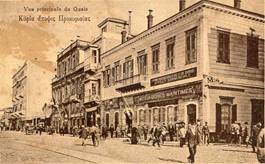 Today is September 8th, 2007. Eighty five years ago it was the final day of a great dream by Venizelos that was called ‘To megalo idea’ (The big concept). Thousands of people, citizens and refugees from neighboring areas have gathered in my city of Smyrna awaiting their destiny after just a few years of liberty and rejoicing. They did not know what would become of them, but their thoughts were centered on the fact that they were the real owners of this land, that for centuries no force was able to uproot them from Asia Minor. Countless conquering armies including Persians, Temurlenk, Selchuk Turks and Ottomans faced the same reality that in the end these lands were inhabited by Hellenes, and it was their motherland, and they would not leave it regardless of oppression and hardship.
On September 9th, 1922 Turkish National forces entered Smyrni (today, Izmir in Turkish), occupying it, and after burning down the Armenian and Greek quarters, got rid of the remaining Orthodox Christian people by actually forcing them into the sea. After eighty five years there are just a few remnants of these people who had changed the course of history, the music of a
 whole nation, the arts and philosophy of the Western Civilization several times over. But today, they are lost in the pages of history books, a few articles and documentaries. This is a short history of Smyrnean Hellenes in the late 20th Century by a Smyrnean Greek who has lived most (if not all) of his life in the city.
The Hellenes of Asia Minor survived. A small Greek population in Smyrni survived with the help of their neighbors, some in the wider Aegean region in remote villages did by the rule of proximity. But then the Lausanne treaty forced most to take part in a population exchange of Muslims of Greece with the Hellenes of Anatolia. Two million Greeks moved to Greece and some 300,000 Muslims moved to Turkey. But again Hellenes of Asia Minor survived mostly in Constantinopolis (today Istanbul), Smyrni and Eastern Thrace. The Christian population of these areas was excluded from the treaty so many families moved to these pockets to prevent exile which meant losing their property and worldly possessions.Giorgos Seferis (1900-1971), a fellow Smyrnean and Nobel Prize Winner in Literature put it the best; “Who will discover the truth? The wrong has been committed. The important thing is who will redeem it?"
 There has been a commotion going on the streets for a few days now. Smyrneans are preparing for the great yearly celebrations of September the 9th, the day of ‘liberation’ of Smyrna from ‘the Greek yoke’. The day Turks ‘finally put the Greeks to the sea’ to declare independence in Asia Minor, later founding the Turkish Republic. The day Greek civilization lost its foot in one of the major areas of cultural influence, Ionia, the land of Homer (not Simpson).
 At a university meeting, a few years back in Constantinopolis’ Bosphorus University, I was among a bunch of international students, Greeks included. As usual the subject matter danced around the fact that ‘Turks threw Greeks into the sea in Smyrni’, and jokes were made and people exchanged ironical remarks. One of the Greek guys suddenly pulled his pants down, to show he had bathing trunks instead of boxers as he said ‘I am prepared! We Greeks know how to swim. But I wonder what should happen if you guys try to follow us.’ It was really good and ended the discussion. It was also good to see the levelof maturity coming from my fellow countryman.
But how should I explain the joke to descendants of thousands of Greek families of Smyrni? The joke was on them! The celebrations commemorating the birth of a modern nation is based on destruction of the civilian people of the city. Of course, this is a fact that is omitted from school books. They boast the fact that they have dumped the enemy into the ocean, but omit the fact that the very enemy were only the civilians of the city. The Greek army has already deserted the area.
For those who remained, then came the ‘property tax’. After two decades of rebuilding, recuperation and lessons in survival, the so called minorities of Turkey were up against a fascist law of discriminating ‘property tax’ of the forties. Turkization (a term borrowed from Matthew Barrett, or Turkification) of Asia Minor, which began in 1860’s, through the Armenian genocide and uprooting of Pontus Greeks, Assyrians and Kurds, was not able to get rid of all non Turkic elements from the area. In fact together they outnumbered Turks in every aspect. The final blow in that endeavor was to adopt a law that was influenced by National Socialism prevailing in Germany at the times. This law stated that all non-Muslims had to pay a special tax
 proportional to their property or to face exile to the working camps in Eastern Turkey, with a glitch on the word ‘proportional’. The aim was said to be the dwindling conditions of the state during wartime, but there was no explanation as to why only the minorities had to give a hand to the government who refused to take part in the war officially but covertly supported the Axisforces in every manner.
 The glitch on the ratio of the tax was the fact that it was not a percentage; it was a multiplication factor! A non-Muslim who for example owned 1000 lira worth of land had to pay, say 10000 lira (Yes, ten thousand) worth of taxes, or else to the working camp where they had to help build a railroad under harsh conditions of winter in mountainous Eastern Turkey. Many Greek, Armenian and Jewish families sold everything they owned for ludicrous prices and fled the country. The many Armenian craftsman of Istanbul had to bribe the authorities to keep their stores; those who couldn’t had to actually go to the work camps only to die there. It was the final major tragedy that today no one ever talks or writes about. Thousands of craft shops, factories, trading stores changed hands during these years, and again thousands of residential and communal real estate fell into the hands of Turks including even some church buildings.
 Finally the majority of the economical forces of Asia Minor were in the hands of Turkish ‘entrepreneurs’, and the only evidence of all that happened were in the memories of Asia Minor Hellenes (Roumoi) and Armenian Diaspora. The tiny and poor Greece to the west was no major threat both in military or political terms. But there was a little pocket of land left where Greeks were living side by side with Turks: Cyprus. (Except maybe Western Thrace where the Muslim population was living-they still do-as Greek citizens with rights to follow their religious ways and to education in their language.)
 Then there was the Cyprus crisis. In 1955, the masses in Constantinopolis, already uneasy because of the news from Cyprus, were agitated by the authorities with a lie that the house of birth of Mustafa Kemal, the founder of Turkish Republic, in Thessaloniki was bombed and burned down by Greeks. They immediately formed a mob to destroyed everything they related to a non-Muslim in the city. They burned Churches, apartment buildings, actually every building that did not post a Turkish flag. The official toll was 11 murders, hundreds of wounded, 73 churches, 1 synagogue, 26 schools, 8 fountains, 2 monasteries and 5538 properties destroyed. The authorities gathered up the usual suspects; the communists including four writers. Nobody got any jail time or punishment. A record of Turkish eye witness summarizes the tragedy. Astore owner tells his story:
“I took the Greek kids to their homes and arrived home. Our house was just across from the mosque. My grandma was sitting by the door, trembling and crying. When she saw me she said; ‘My son, please do not touch anybody’s belongings, these are our long time neighbors’, and cried more. Somehow, some time later someone brought a plate stolen from Greeks to our house. My grandma refused to touch it and she said: ‘I won’t let this thing enter my home, we would be done with’. To the last moment we were with Anastas and Niko, the pastry shop owner. We resisted against the demolition of the pastry shop to our capacity. But then a huge crowd arrived, oh, they were too many for us, they finally tore the store down.”
Between 1955 and after the events of the Cyprus conflict in 1963, the majority of Hellenes left the country for Greece and the United States. But that was an exile in reality. They did not want to go. The following personal account tells the story:
Between 1955 and after the events of the Cyprus conflict in 1963, the majority of Hellenes left the country for Greece and the United States. But that was an exile in reality. They did not want to go. The following personal account tells the story:
“We, most of us, had forgotten the events of 1955. They say, even some Greeks say, that we left after 1955. No, we did not leave after 55, maybe only 50 families (from Istanbul-author’s note) left then. But after 63, Cyprus was on fire, demonstrations, megaphones everywhere, on every wall in Istanbul it was written ‘Death or division!’, ‘Citizens speak Turkish!’, it was impossible for us and that was the fact. We were afraid to even say our names, to admit that we are Greek. We used to tell the kids that they should not speak Greek in public or if they have to, to speak in a low voice. You can immediately see the changes in people’s faces when they recognize you. This is my fatherland. I was born here, I lived here, as did my mother and his as well. How can I go? We are not immigrants; I am not one of these who went to America. I love my fatherland, I also love Greece. Then the immigration started in 64 after 63. We never meant to go. My husband used to say: ‘If we have to, let me be the last.’”
Personal memories fell into this timeframe. My mother being of Circassian origins, and my name Turkified on the books to prevent me from mishaps as my father used to tell me, I had no serious problems growing up in the 60’s in Smyrni. But then there was school. They had copies of my papers and there it was written that I was a Christian.
There were questions and sighs among peers and innuendos in the non-obligatory religious  classes. Then again, there was Sofia F. (Now happily married and lives in Switzerland) In the sixties, independent of your sex, if you were a Hellene, a kid and in Smyrni you’ve got to know how to take a good beating. One of my friends (a Turk, now living in Belgium) was deeply in love with Sofia. And Turkish kids used to make fun of her, intimidate and try to beat her during breaks. My friend who was in love was so scared he couldn’t go and fight for her. But I was always there to save his pride. My mom never understood why I came home from school everyday beaten up and mud on every inch of my clothes. Questions directed to fellow kids were always unanswered. Teachers never got wind of it. I never told, and nobody ever, ever was able to touch Sofia! (If only anyone could, sofia in Greek means virtue)
 classes. Then again, there was Sofia F. (Now happily married and lives in Switzerland) In the sixties, independent of your sex, if you were a Hellene, a kid and in Smyrni you’ve got to know how to take a good beating. One of my friends (a Turk, now living in Belgium) was deeply in love with Sofia. And Turkish kids used to make fun of her, intimidate and try to beat her during breaks. My friend who was in love was so scared he couldn’t go and fight for her. But I was always there to save his pride. My mom never understood why I came home from school everyday beaten up and mud on every inch of my clothes. Questions directed to fellow kids were always unanswered. Teachers never got wind of it. I never told, and nobody ever, ever was able to touch Sofia! (If only anyone could, sofia in Greek means virtue)
 There was one school, one curriculum, one language, one nation, one truth. We were severely assimilated and most families did not intervene. Tacit memories of the near past were haunting our parents. They were in a way losing their identity as Hellenes but not as Smyrneans. Simply, they did not want to leave the city. They’ve had many chances and they have said ‘Ohi’. (Many Minor Asiatic Hellenes of my generation do not speak Greek, most of the kids in Smyrni now are only half Greek and Greek is no longer their mother tongue)
The official history books in Turkey will tell you that when Ottoman Empire was weak due to ill-management of the Sultans during 1800’s, Armenians revolted in eastern Turkey and the army had to deal with them. All Armenian casualties were a result of this insurrection and hence were casualties of war. There is never a mention offorced immigration.
The Ottoman Empire sided with Germans due to its long term friendship with them during WW1, and although the Turks defended the Dardanelles heroically, they finally had to accept defeat not because they were defeated, but because their allies were defeated. After the war the triumphant Western European countries decided to divide the country into Greek, French, Italian and British zones and made the Greeks invade Western Asia Minor. (No mention of again Armenia and Kurdistan which were the integral part of the Sevres Agreement which instituted no Greek, French, Italian or British zones but the foundation of Armenia and Kurdistan and annexation of Aegean Asia Minor and Thrace to Greece) Then, Mustafa Kemal organized a National movement against invasion and won the liberation war by defeating the invasion forces and by chasing them back to the sea in Smyrni. Then afterwards, all the above forces who once tried to invade Turkey, now tried to overthrow Mustafa Kemal and his new republic continuously through assassination attempts, terrorism, a non-fact they called the Kurdish problem, Armenian problem and of course Hellenism and Zionism among the leading perils.
Well, the above paragraph was not a joke. If you ask anybody in Turkey to write one short paragraph about 20th Century history of their country that’s what you’ll get. (Except for the facts mentioned in parentheses and puns of course) History books stop at 1940’s, just after Mustafa Kemal’s death and in those books everything just happens, there are neither why’s nor how’s.
In the 70’s the only American high school in the city was for girls only. Therefore I attended a special government school, taken over from a Levantine (meaning predominantly Catholic people of Italian and French origins in Asia Minor as Roumoi means Hellenes living under Turkish rule) family under the promise that the language of education would be English and they should not mess the curriculum up and keep certain principles that gives kids freedom not heard of at the time. It was an interesting experience. I had some excellent English, American and Australian teachers as well as some great Turkish ones. But the 70’s were turbulent in Turkey. The cold war influence on the country resulted in radicalization of politics and anarchy and terrorism were everywhere. People were being killed, jailed and disappeared. In this environment, the school provided a safe and secluded haven as well as a source for independent and rational thinking. I trace back all my successes or failures to those years.
Actually, the country was so divided on political views; no one really cared about ethnic origins. They had plenty of reasons to kill each other, to jail each other, to blame each other, or hurt one another’s feelings, so this forever long list of reasons never came down to ethnic differences. During these years the only ethnicity people talked about was Kurds, but not in ethnic terms but of them all being communist separatists. It was a real catastrophe as the great Turkish-Armenian journalist Hrant Dink who was recently assassinated in Constantinopolis once said that these turbulent years were the only times he forgot about being an Armenian and started feeling like a citizen, a political human being.
Then I escaped to Paris. I thought I had had it! After two years of training in drama and TV production in Paris and drinking and going to Israel at the height of Arab-Israeli war to shoot a documentary and some more drinking and traveling around Europe and some more serious drinking, falling in and out of love every week or so and some more more serious drinking, my father made me (physically) come home and attend a prominent American university in Constantinopolis to be educated in Business Administration. Although I squeezed a Political Science double major in, yes, I did graduate from there finally.
My education in Paris was my access to what I used to call ‘real books’ for the first time. I was able to read everything that was illegal in Turkey at the time, and moreover I was able to meet people like Armenians, Greeks and Turks who had long ago fled the country. We used to read Nazim Hikmet (one of the great Turkish poets who died in exile in Russia) in secret in Turkey. There I was attending a conference by his wife Vera and actually was able to talk to her. I had the chance to listen to first hand stories of people who had to leave Turkey for either ethnic or political reasons, about their trials and tribulations. But most importantly their craving for their motherland. I learned that there’s no cure for this illness and it’s fatal. But more later on this.
 The 80’s were a dictatorship. All the dissidents of the community were either forced out of country (and I don’t mean just non-Muslims), or jailed, or disappeared. Everybody who thinks or at least thought about something was converted to non-thinking, apolitical human being of today’s Turkey by force or assimilation. (You couldn’t even get a job if you were suspected of your ideas and if there was a file about you with the police.) Universities were brought under one organization that fed them with a uniform curriculum and all free research was banned. (It still is today) The authorities made it impossible for the minority (non-Muslim) foundations to own or repair property. This caused havoc at first but due to international indifference nothing came out of it except many monasteries, churches and other buildings belonging to these foundations became obsolete over time, only to be demolished and apartment buildings built in their places. Here some blame should also go to Hellenic and Armenian religious authorities in Turkey as well. Although they serve (and have served throughout the ages) a necessary and irreplaceable function to cement their respective communities and provide leadership, at that time they were admittedly scared by the military government and the influence of the military afterwards. They did but little to influence the international public opinion to change this fate until very recently. For Hellenes it took a major religious university and monastery in Princess Islands to be closed, and for Armenians, the assassination of a major journalist in Istanbul.
I fled again. Now to the United States. I was married to a Cretan, and we were thinking about a baby. I lived in the US most of the 90’s and there is only one story I’d like to tell about these years. It is the story of Mr. Ian. (I am not using his real name and some private facts are distorted out of respect to his beloved family)
I met him in California in 1996 when he was well over 80 years old. I was strolling along downtown San Jose when I saw his store, an antique shop full of real interesting stuff such such as old 78 rpm record players, tens of radio receivers from 20’s and 30’s, all kinds of electrical junk for a junky geek in San Jose. I went in to his store and started to ask about the stuff, prices and alike. He was not chatty at first but he noticed my accent and asked where I was from. When I answered, he was talkative instantly and in perfect Turkish for that matter. I gasped and asked who he was. Instead he asked me if I liked rembetika and Turkish music while he showed me the way to his inner sanctum of the shop. I said, but why yes, of course! Then it was heaven on earth. On the shelves were hundreds and hundreds of 78 rpm records of Smyrnean music and Turkish music from the beginnings of the Century we were about to end, and all in mint condition. Ian was from Constantinopolis, his father was a rich businessman who died in 1916, not of natural causes. His father’s small collection of 78 rpm’s got larger until his family moved to the States in the early 30’s and these were almost their only possession that they carried over the ocean. When our conversation got deep and after we exchanged experiences (his of course outweighing mine) and thoughts, Ian smelled me, and said I smelled like the motherland. That was impossible I said. I was in the States for more than 5 years without even visiting back but he insisted. We wept.
He had left Constantinopolis one April evening on a boat that took his family to Marseille. From there they decided to stay on the ship that took them to New York. He worked at a factory in Queens as a handyman, and later with help from his elder brother he opened his first record store in Astoria. Retiring years later in San Jose he turned his store into an antique shop. Ian died in 2006. For the four years I lived in the United States after we met, I tried to visit him every holiday even though we lived thousands of miles apart. We would talk about the fate of people that came from our neck of the woods. We would listen to Sotiria Bellou, Roza Eskenazi and Aghapikos Tomboulis for hours. I would bring him ouzo, he would share kopiks his daughters cooked for him with me. Or we would spend hours just staring at the walls of his store. We would do nothing but share existence in the same environment. Sometimes, maybe wishful thinking on my part, I would think I provided him with a sense of continuity, and an oasis in his desert of solitude. Ian died and with him he took with him my heritage that I never even knew before I met him. I am sure now, he is listening to Bellou live.
Here in Smyrna life is stagnant now. Decades of wrong economical decisions, negligence of the  government, hostility of current administration toward anything western or civilized left Smyrni like a rusty chain on the dock. (the Prime Minister even called Smyrni ‘Ghavour Izmir’ meaning Izmir the Infidel because people here still drink in Ramadan, the holy month of fasting.) It looks like a small town with 2 million people wandering the streets every day aimlessly. The industrial boom in nearby Magnesia helped a little and fueled exports in one of the largest ports in the Aegean in Smyrni, but that was not enough to feed more than two million people.
 government, hostility of current administration toward anything western or civilized left Smyrni like a rusty chain on the dock. (the Prime Minister even called Smyrni ‘Ghavour Izmir’ meaning Izmir the Infidel because people here still drink in Ramadan, the holy month of fasting.) It looks like a small town with 2 million people wandering the streets every day aimlessly. The industrial boom in nearby Magnesia helped a little and fueled exports in one of the largest ports in the Aegean in Smyrni, but that was not enough to feed more than two million people.
Traditionally the area was known for its culinary exports. But these were under the supervision of or traded by the so called minorities and since they are long gone and since we now live under Global Economy, Smyrni is not in very good shape and the future does not look bright either.
I am no crazed nationalist. I just tried to paint a human portrait the best way I can. Finally, I have to mention one crucial fact most reviewers neglect when dealing with matters Turkish. Since the Ottoman times, rulers in Turkey never valued human life, be it Muslim, Christian or Jew. (I cannot say for sure if this has anything to do with religious culture) Muslim people were called ‘taba’ and were ‘kul’ (slaves) of the Sultan. As long as they served and fought for the state they were fed. Non-muslims were given the right of living under severe restrictions provided that they paid taxes in the form of money, goods and children. I always wanted to provide myself with a rational explanation as to why people are capable of performing such atrocities against their neighbors who they have lived together with for centuries. Crete is a good example, Smyrni is another, Pontus is a totally amazing story. Constantinopolis was the first metropolis of its time with such diverse ethnicities living peacefully together. And after just100 years it’s all gone. Neighbors kicked neighbors out.
I am no crazed nationalist. I just tried to paint a human portrait the best way I can. Finally, I have to mention one crucial fact most reviewers neglect when dealing with matters Turkish. Since the Ottoman times, rulers in Turkey never valued human life, be it Muslim, Christian or Jew. (I cannot say for sure if this has anything to do with religious culture) Muslim people were called ‘taba’ and were ‘kul’ (slaves) of the Sultan. As long as they served and fought for the state they were fed. Non-muslims were given the right of living under severe restrictions provided that they paid taxes in the form of money, goods and children. I always wanted to provide myself with a rational explanation as to why people are capable of performing such atrocities against their neighbors who they have lived together with for centuries. Crete is a good example, Smyrni is another, Pontus is a totally amazing story. Constantinopolis was the first metropolis of its time with such diverse ethnicities living peacefully together. And after just100 years it’s all gone. Neighbors kicked neighbors out.
In the place of the whole Armenian quarter in Smyrni sits a park. The trees on it rot from their roots and fall apart, so that they have to replant them often. The merry days of my childhood when Los Paraguayos, Enrico Macias and Dario Moreno sang in tavernas of the Kordelia are gone. I think maybe it had something to do with the way we value human life in our neck of the woods.
Efstratios Moraitis
September 8, 2007
Subscribe to:
Posts (Atom)